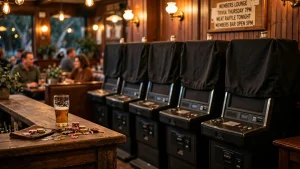
A practical look at Adelaide gaming-room hours, venue information, distance, online rules and the fine print around promotions.

An opening time is not the same thing as the hour when pokies are switched on. A venue may be open for food, drinks or other services while its gaming room follows a separate schedule. For anyone trying to establish whether a particular Adelaide room is operating now, the useful detail is the venue’s current information about its gaming machines—not simply a general statement that the premises are open.
That distinction matters most at the edges of the day. A late-night listing may refer to the venue as a whole, while an early-morning opening time may not mean that pokies are available from the moment the doors open. The same caution applies to claims about machines being available at six or seven in the morning: a time attached to a venue should not automatically be read as the operating time of its gaming room.
Hours can also be presented in ways that are easy to misread. A public listing may give a broad trading schedule without specifying the gaming area; a venue’s own notice may be more precise, but still need checking for the day in question. The most dependable approach is to confirm directly with the venue whether its gaming machines are operating at the time being considered. If the information is unclear, a phone call can settle what a broad online listing leaves open.
This is not merely a matter of convenience. For a person making a trip across Adelaide, the difference between a building being open and its gaming room operating can determine whether the journey has any point. “Open now” is a moving claim: it depends on the local time, the day and the venue’s own schedule. An old listing can remain visible after hours change, and a general business-hours label can conceal the detail that matters.
There is a quieter distinction too: a room’s operating schedule says nothing about the character of its machines or the outcome of a session. A door that is open does not promise a particular return, and a venue’s hours cannot establish what a machine will pay. Those are different questions, even when they are compressed into the same search for a nearby place that is open.
The public rules around gaming rooms increasingly concern who is present while machines are running, not just when a venue opens. A report by regionriverina.com.au says that, from 1 July, venues with more than 20 gaming machines are required to have a dedicated responsible gambling officer (RGO) on duty during machine operation. The requirement ties the officer’s presence to the machines being in use. It is not simply a staffing condition attached to the venue’s general trading hours.
For anyone checking a room’s schedule, that is a useful distinction: the relevant operating period is the period when its machines are running. The reported requirement does not mean that every Adelaide venue has the same hours, or that an RGO’s presence determines when a room opens. It describes a responsibility applying to larger gaming-machine venues while their machines operate. A schedule remains a venue-specific matter.
The detail reflects a broader shift in how public gambling spaces are understood. A gaming room is not just another part of a club or hotel that happens to have its own timetable. Its operation carries responsibilities that are attached to the activity itself. The room’s hours, then, are practical information; the officer requirement is a condition of operation for venues above the stated machine threshold. One does not supply the other.
Adelaide’s early-opening and late-closing questions are therefore best answered at venue level. Before setting out, it is sensible to establish whether the gaming room—not merely the broader premises—is open at the intended time, and whether that schedule applies on that particular day. For a late visit, the same check avoids confusing a venue’s closing time with the point when its machines stop operating. For an early visit, it prevents an advertised opening from being mistaken for immediate access to pokies.
The phrase “open now” sounds simple because it asks for a yes or no. In practice, it contains several small questions: which premises, which part of them, and which activity? A current answer needs to identify the gaming room’s operating hours, rather than rely on a general listing or an assumption based on the venue’s other services.
Schedules belong to venues, not to Adelaide as a whole. Confirm the room’s hours directly; treat broader opening labels as incomplete until they say what is open. The distinction is modest, but it can save a wasted trip.
Choosing pokies in Adelaide for 2026 starts with checking the details that matter to you, such as licensing, minimum deposits and payout information. This list offers a concise reference to the available facts for each operator.
SpinsUp
SpinsUp is listed with a Curacao Gaming Control Board licence, OGL/2023/174/0082, held by Dama N.V.
Thor Casino
Thor Casino is licensed in Curacao through Antillephone N.V. (Versus Odds B.V.). Its stated minimum deposit is EUR 20.
Kingmaker
Kingmaker lists crypto payouts at around 90 minutes and fiat payouts at 1–5 days. The minimum deposit is A$30.
MrPacho
MrPacho lists crypto payouts at 30–120 minutes and fiat payouts at 24–72 hours. Its minimum deposit is A$30.
Wild Tokyo
Wild Tokyo is licensed in Curacao and lists a minimum deposit of A$10. Its stated payout times are 30–60 minutes for crypto and 1–5 days for fiat.
JeetCity Casino
JeetCity Casino is listed with a Curacao eGaming licence held by Dama N.V.
Roby Casino
Roby Casino is listed with a Curacao eGaming licence held by Roby Games Ltd.
Playfina Casino
Playfina Casino has a Curacao eGaming licence held by Hollycorn N.V., stated to be in place since 2017. Its minimum deposit is A$20–30, depending on the offer.
Golden Pokies
Golden Pokies is listed with a Curacao licence.
DragonSlots Casino
DragonSlots Casino is listed with a Curacao Gaming Authority licence held by Jumpman Gaming Ltd.
“Best” sounds like a verdict. With pokies, it is more often a bundle of assumptions: that a game pays more, that a familiar name makes it safer, or that a run of recent wins says something about the next spin. None of those ideas turns a machine into a dependable source of returns. A ranking can arrange opinions; it cannot make chance obedient.
Each spin is an independent event, determined by a Random Number Generator. The machine does not remember that it has paid out, nor does a losing sequence make a win due. A result from one spin does not improve or worsen the odds of the next. This is the awkward hinge in any claim about the best-paying pokies in Adelaide: past outcomes may feel like a pattern, but they do not establish what the next result will be.
Independence is easy to accept in theory and difficult to feel in practice. People are pattern-making creatures. A machine that has been quiet can seem ready to change its mind; one that has paid recently can seem generous. The language of “hot” and “cold” gives randomness a temperament, as if a machine were a host deciding when to be hospitable. It is not. The metaphor is more comforting than the mechanism.
Return to player, or RTP, can add another layer to the argument. It describes a return setting associated with a game, but it should not be read as a promise about an individual visit or session. A percentage is not a schedule of payments, and it cannot tell a player what will happen over a short stretch of play. Even where an RTP figure is published, it does not cancel the independence of each spin.
There is also a less visible complication. A specialist review has reported that some providers give casinos a choice of RTP settings for the same pokie. On that account, a game with the same title may not have the same return percentage in every casino. The name on the screen, therefore, cannot by itself settle a comparison. A familiar title may travel between venues while its settings differ.
That possibility changes what a confident “best” label can responsibly mean. It may refer to a person’s preference for a theme, pace or style of play. It may reflect an advertised RTP setting, if that setting is stated clearly and applies to the particular version. But unless the relevant setting is known, a claim that one Adelaide machine pays better than another is not a conclusion that follows from the game’s name alone.
The distinction matters for searches framed around the city, the CBD or a casino. A place-name can narrow the setting of a question; it cannot supply evidence about a particular machine’s configuration or results. Nor does calling something the best pokies in Adelaide make it so. The phrase has the neatness of a guidebook heading, while the underlying comparison may depend on details not visible in a title or a promotional description.
Some providers allow casinos to choose between different RTP settings for the same game title, meaning a familiar pokie may have different return percentages at different venues.
The same caution applies to “best paying.” That phrase can sound like a ranking of likely personal outcomes, when the available comparison may concern only a published setting. A higher stated return is not a guarantee that a particular player will receive more, and it does not make one spin more predictable than another. If the setting is not disclosed, certainty becomes especially hard to defend.
There is no contradiction in saying that games can be compared while refusing to promise a winner. Preferences are real; themes and presentation can be judged. Return settings can be relevant when they are identifiable. But chance remains chance, and each spin begins without a memory of the last.
“Best” is not a payout forecast.
A place name can make a venue sound close before anyone has measured the route. Adelaide Airport, the central business district and North Adelaide occupy different points on a map; a phrase joining any of them to pokies does not, by itself, establish that a particular gaming room is there, how far away it is, or whether it is open to the public. Naming a nearby room on that basis would turn geography into guesswork.
That distinction matters because “near” is not a fixed distance. For someone arriving at the airport, it might mean a short journey before a connecting trip; for a resident in the CBD, it might mean a venue within walking distance. North Adelaide adds another neighbourhood label, while “Adelaide, Victoria” points towards a different place entirely: Adelaide is also the name of a town in Victoria. Similar wording can therefore describe different journeys, not different qualities of play.
Nor does a convenient address amount to a recommendation. Proximity says nothing about a room’s atmosphere, the games available, the cost of getting there or the care taken when a patron appears distressed. Those are separate questions, and a map pin cannot answer them. A venue may be close in the abstract and inconvenient in practice; a short straight line is not necessarily a simple route.
There is one venue-level safeguard relevant to the scale of a gaming room. A report by regionriverina.com.au says that, from 1 July, a venue operating more than 20 gaming machines is required to have a dedicated responsible gambling officer (RGO) present while those machines are running. The threshold concerns the number of machines at the venue, not its postcode or its distance from the airport. It is a staffing requirement, not a rating of the venue and not evidence that a particular Adelaide room meets it.
The distinction is easy to lose when location and quality are folded into the same description. “Near the airport” sounds useful; “best near the airport” sounds like a verdict. But a verdict needs grounds beyond a place label. Without a confirmed venue address, even the first description remains unanchored, and no reliable journey can be calculated from it.
The city’s names do less work than they appear to. “CBD” narrows the map in conversation, but does not identify a club or gaming room. “North Adelaide” gives a district, not a door. Airport wording may refer to the terminal, the wider airport precinct or a journey beginning there. Each interpretation changes what “near” might mean.
So the useful boundary is a modest one: location can help organise a search once a venue is identified, but it cannot supply the missing venue or certify its quality. Distance is a practical fact, not a promise. A map needs an address first.
A venue’s reputation is often built from what is visible: the layout, the service, the noise level, the machines. Accountability belongs to a less theatrical part of the room. It asks what staff are expected to notice, and what happens to that observation once it has been made.
A regional report described a transition period for venues to remove signage and introduce responsible gambling officers (RGOs). It said venues would have a one-month grace period for those changes. The detail matters because a rule does not arrive fully formed at the venue door: there is a period in which old arrangements are meant to give way to new ones. The report presents that interval as a practical transition, not as proof that every Adelaide venue has already made the change.
The same report described a gambling incident register that venues would be required to keep. It is intended to record occurrences, including situations where a patron’s behaviour suggests they may be at risk of gambling harm or already affected by it. That makes the register more than a tally of dramatic events. Its purpose is to capture signs that might otherwise pass as ordinary activity in a room designed around repetition.
A written record also changes the nature of responsibility. Concern is no longer only a private impression held by a staff member; it becomes something the venue is expected to document. That does not, by itself, establish how a particular incident was handled, or show whether a venue’s practices are consistent. It does identify a formal point of accountability: behaviour indicating possible harm is not meant to disappear into the general bustle.
This is a different way to think about Adelaide’s pokies venues than simply asking which room is “best”. Reporting requirements do not rank venues, and an incident register is not a scorecard for visitors. They describe obligations and processes, not the atmosphere of a particular club or the quality of its service. Without venue-specific information, those distinctions matter.
The register also puts a modest but consequential idea on paper: the room is not merely a place where machines operate. It is a workplace with duties around the people using them. The requirement to record warning signs gives those duties a traceable form, even though a record alone cannot tell the whole story of what followed.
That is the unglamorous measure. A venue may be judged by what it offers; its governance is judged by what it is required to notice and record. The paperwork is not the room. But it can show what the room is answerable for.
A promotion can make an online offer look generous while leaving its real cost in the conditions below the headline. That matters as much to someone comparing claims about Adelaide pokies as it does anywhere else: a bonus is not cash freely available for withdrawal, and a “no deposit” label does not explain what happens to any winnings.
Wagering Calculations
Calculate with Bonus
A $500 bonus with a 40x requirement entails $20,000 in wagering before winnings can be withdrawn.
Calculate with Deposit
A $500 deposit plus a $500 bonus at 35x means $35,000 in wagering if the rule applies to both.
The central term is the wagering requirement, sometimes called a turnover multiplier. It states how much must be wagered before bonus-related funds or winnings become withdrawable. A specialist review suggests treating a requirement of 35x or less as a more manageable benchmark, while describing anything above 40x as punishing. Those are that review’s judgements, not a promise about what any particular offer will require.
The calculation depends on what the multiplier applies to. In one illustration from a specialist review, a $500 bonus with a 40x requirement entails $20,000 in wagering before any winnings can be withdrawn. If the rule applies to the deposit as well as the bonus, a $500 deposit plus a $500 bonus at 35x means $35,000 in wagering. The headline amount is only the starting point; the terms determine the base.
That distinction is easy to miss when an offer is presented as a simple addition to a balance. A no-deposit promotion may sound as though it removes the initial cost, but the label alone says nothing about wagering conditions, eligible games, expiry rules or whether winnings can be withdrawn at all. Those details belong to the offer’s written terms, not its advertising shorthand.
Free spins carry a related complication. A specialist review notes that such offers may cap the winnings that can be cashed out. A successful spin, therefore, need not translate into an equivalent withdrawable amount. The cap, any wagering requirement and the deadline for meeting it can each change the practical value of the offer. Fine print is not decorative.
Deposits and withdrawals deserve separate attention. A displayed deposit option does not establish that a promotion is worthwhile, nor does it settle what documents may be needed later. Before a first withdrawal, identity and address proof must be verified. That requirement can make a balance that appears available on screen less immediately accessible than the promotional language suggests.
For claims about online pokies in Adelaide involving real money or a no-deposit bonus, the useful comparison is not the size of the advertised gift. It is the full set of conditions attached to receiving, wagering and withdrawing it. The smallest print often carries the largest arithmetic.
The phrase “Adelaide casino” can suggest a straightforward choice between local rooms and online play. The legal position is less accommodating. Under the Interactive Gambling Act 2001, companies cannot lawfully provide real-money online pokies to people in Australia without a domestic licence. No Australian licences for online casinos have been issued.
That leaves a divide between what an offshore site may accept and what it may lawfully offer here. A site taking Australian customers does not thereby become authorised under Australian law. The prohibition is directed at operators, rather than making an individual player the target of the Act. That distinction matters, but it is not a local licence by another name.
Legal Risk
Under the Interactive Gambling Act 2001, no Australian licences for online casinos have been issued, meaning offshore sites lack domestic legal authorisation.
For people in Adelaide, searching for online pokies does not alter the rules according to distance. A website does not become a local venue because it is accessed from the city, nor does a reference to Adelaide establish that an online casino is authorised to serve Australians. The same applies to claims about high stakes, maximum bets or supposedly generous returns: those claims do not answer the more basic question of whether the service may lawfully be offered.
There is a further difference between player exposure and player protection. The law targets the companies supplying prohibited services; it does not make a player’s use of an offshore site the same offence. But the absence of player liability is not a guarantee of practical protection. If an offshore casino withholds winnings, an Australian player has no legal recourse in Australia to compel payment. A promise displayed on a website and a remedy enforceable at home are different things.
That difference can disappear in promotional language. “Available to Australians” describes access, not legal status. A claimed licence from another country is not an Australian domestic licence, and a payment option or polished account page does not supply one either. In an online transaction, the operator may be far beyond the reach of the institutions that give local consumer protections their force. The welcome mat is not the same as a remedy.
BetStop also has a boundary that is easy to miss: it applies to Australian-licensed operators and does not bind offshore sites. Since no Australian online casino licences have been issued, BetStop should not be mistaken for a mechanism that can exclude someone from every offshore gambling website. It cannot make an unlicensed site subject to Australian controls.
The attraction of online play may be framed as convenience or choice, but the legal divide is not a matter of postcode. “Best-paying pokies” claims cannot bridge it; neither can an online service’s willingness to accept a customer. In this market, access and lawful provision are separate questions, and the distance between them is where much of the risk sits.
No local remedy.
A request for pokies that are open through the night sounds like a simple matter of finding a door that stays unlocked. In practice, a venue’s general opening hours and the hours when its gaming machines operate are not necessarily the same thing. A late bar, restaurant or club does not, by that fact alone, establish that its gaming room is available at every hour.
That distinction matters to anyone trying to establish whether a particular Adelaide venue is open now. Opening times can change, and a broad label such as “24-hour venue” is not a reliable substitute for current information about the gaming room itself. The useful detail is venue-specific: whether the premises are open and whether the machines are operating at the time in question. Those are separate conditions, not a single promise.
Nor should a search result, an old listing or a venue’s general description be taken as proof of current machine hours. Checking directly with the venue is the practical way to establish its present arrangements. The word “open” can do a surprising amount of work while saying very little.
The rules around staffing offer a more precise point of reference. A report by regionriverina.com.au says that, from 1 July, a venue with more than 20 gaming machines is required to have a dedicated responsible gambling officer (RGO) on duty whenever those machines are operating. The condition is tied to machine operation, not simply to the building being open. It therefore makes the operating status of the gaming room relevant in its own right.
That requirement is not evidence that a venue is open all night, or that its machines run for the whole time its doors are open. It describes a staffing obligation when the machines are in operation. For larger rooms, the RGO is part of the venue’s oversight while play is taking place; the rule does not supply a timetable.
The search for late-night access can blur these questions together: a venue’s hours, a room’s hours and the period when machines may be used. Keeping them apart avoids turning a general opening claim into an unsupported statement about pokies. Current hours belong to the venue to confirm. The staffing rule sets a condition for larger gaming rooms, not a clock.
No midnight shortcut.
A Crown name in a request for Adelaide pokies can make a place sound settled before the place itself has been established. The name may point to a particular venue in someone’s mind, but it does not prove that a Crown casino operates in Adelaide, or that any particular machines are available there. A venue claim needs a venue record; a machine claim needs more than a familiar brand.
That distinction matters when the search is for the best pokies room, too. A room’s reputation and the games installed in it are separate questions. Without confirmed details about an Adelaide venue and its machines, there is no sound basis for ranking a Crown room against other local options. The word “best” cannot do the work of evidence.
Return percentages offer another reason to be cautious about comparisons. A specialist review reports that some game providers give casinos a choice of settings for a pokie’s return to player (RTP). The same title may therefore be configured with different return percentages at different casinos. A figure attached to a game in one place should not automatically be carried over to another.
That is not a small footnote. A game’s title can stay the same while its configured return differs; a familiar name is not a guarantee of identical terms. Any RTP claim needs to be tied to the specific game and the casino setting in question. Without that connection, a comparison may look precise while resting on an assumption.
The question about the maximum cash payout also needs a defined object. It could refer to a particular machine’s prize, a venue’s payment practice or a limit attached to an individual payout. Those are not interchangeable. A venue name alone cannot establish which meaning applies, or what amount would be available. No maximum can responsibly be assigned to an unconfirmed Adelaide room.
This is where search language compresses several uncertainties into one phrase: a location, a brand, a set of machines and a payout expectation. The result can sound like a ready-made recommendation. It is not. The careful distinction is between what a venue is, what games it offers, and what settings or payout conditions apply to those games.
Names travel easily. Settings do not.
A club in Adelaide’s central business district can mean a place for meals, events and ordinary social life; the word alone does not establish what is available in its gaming room. Nor does a reputation for a lively room settle whether its pokies suit any particular measure of “best”. A venue’s social character and the mechanics of a machine are different things, though they are often compressed into the same short description.
That distinction matters when comparing clubs. A name on a map is not a measure of the number or type of pokies on offer, and a club label is not evidence about the quality of a gaming room. The language of rankings can make a local choice sound more objective than it is. In practice, “best” may describe atmosphere, convenience or personal preference; it cannot turn a random game into a reliable source of returns.
Age is less ambiguous. In Australia, gambling is restricted to people aged 18 and over, including gambling on pokies. It is a nationwide threshold, not a condition that changes with the suburb, the club’s membership model or the style of gaming room. That clear boundary sits alongside a less tidy reality: people can experience gambling harm in settings that are also designed for socialising, eating or entertainment.
Responsible-play tools address some of that risk without making gambling predictable or harmless. Deposit and loss limits can place boundaries around money; session time limits can mark a stopping point; self-exclusion can prevent access to gambling services covered by the relevant arrangement. These measures are safeguards, not evidence that a venue or machine is safe for every person. Their usefulness depends on the person’s circumstances and on what the particular service makes available.
Self-exclusion is especially relevant to searches about pokies around the CBD. It is not a way to identify a better room, but a step away from gambling access. In Australia, BetStop applies to Australian-licensed operators and does not bind offshore sites. That limit matters: a tool cannot control services outside its reach.
A club’s civic role may be convivial; the machine remains indifferent. The age rule is simple. The human consequences are not.
Cashless payment has become part of the language around pokies, though the mechanism matters more than the label. PayID is an alias for a bank transfer through Australia’s New Payments Platform (NPP): an email address, mobile number or ABN can identify the recipient instead of a BSB and account number. The NPP is supported by all major banks, and its transfers use end-to-end encryption.
That describes how money moves, not what stands at the other end of the transfer. PayID support does not establish that a gambling service is licensed, that a pokie is fair, or that its return settings are transparent. Specialist gambling reviews have reported that some Australian banks, including members of the Big Four, sometimes block PayID transfers to merchants identified as gambling businesses. Bank policies can change, and a payment method is not a verdict on the service.
There is a further distinction between cashless gaming at a physical venue and sending money to an online operator. A familiar transfer system does not make real-money online pokies lawful for Australian residents. BetStop applies to Australian-licensed operators; it does not bind offshore sites. Where an operator allows withdrawals, identity and address documents should be checked before the first withdrawal, rather than discovered as a condition at the moment money is requested.
The phrase “best pokies in Newcastle and Adelaide” joins two cities without establishing a shared venue, game selection or payment arrangement. Newcastle is not an Adelaide suburb, and a payment method cannot bridge that geographical gap. A local cashless system, if offered by a venue, is a separate matter from PayID’s role in bank transfers.
The useful distinction is plain: PayID identifies a transfer recipient. It does not certify the recipient.
Yes, Australian players can legally play on offshore sites that accept them. However, offering real-money online pokies to Australians without a domestic licence is illegal for operators, and no such licences have been issued; players have no legal recourse in Australia if an offshore casino withholds winnings.
You must be at least 18 years old to gamble online in Australia.
Check the wagering requirement and withdrawal limits before accepting a promotion. For example, a $500 bonus with a 40× requirement means $20,000 in bets before winnings can be withdrawn; if the requirement applies to a $500 deposit plus a $500 bonus at 35×, it means $35,000 in bets. Free-spin winnings may also be capped.