RTP figures describe long-run designed returns, while game settings, venue details and “open now” listings have important limits.
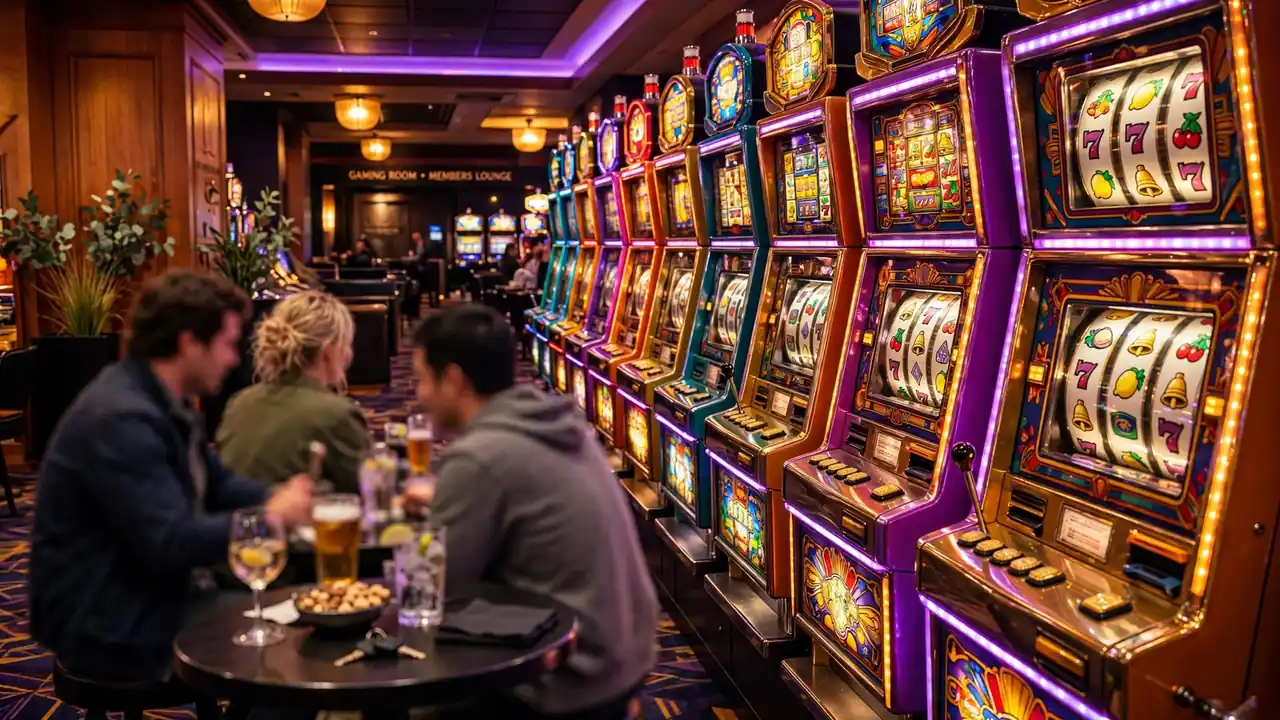
A return-to-player figure looks like a neat answer to an untidy question: which pokie gives more back? It describes the share of wagers a game is designed to return over extended play, rather than predicting what happens in a particular session. That distinction matters in any comparison of Melbourne casinos. A percentage attached to a game is not a promise attached to a player.
There is another complication. A specialist review reports that some providers let casinos choose between different return settings for the same pokie. The title on the screen, then, may not be enough to establish which setting is in use. Identical artwork and rules can conceal different configured returns at different casinos. A figure copied from a review or a game listing may therefore describe one version, not every installation bearing that name.
That makes claims about the best-paying pokies in Melbourne harder to assess than a ranked list suggests. Unless the setting can be tied to the particular game installation, a comparison risks putting unlike versions side by side. A venue’s name, the game’s popularity, or its familiar theme does not settle the question. Nor does a return figure alone establish that one casino is better overall; it addresses only one feature of a game’s design.
Choosing pokies for a Melbourne-focused shortlist means looking for clear, relevant details before deciding where to play. These brief verdicts highlight the information available for each listed operator.
SpinsUp
SpinsUp is listed with a Curaçao Gaming Control Board licence, OGL/2023/174/0082, held by Dama N.V.
Thor Casino
Thor Casino is listed with an Antillephone N.V. licence in Curaçao, with Versus Odds B.V. named as the associated entity. Its stated minimum deposit is EUR 20.
Kingmaker
Kingmaker lists a minimum deposit of A$30. Its stated payout timing is around 90 minutes for crypto and 1–5 days for fiat.
MrPacho
MrPacho lists a minimum deposit of A$30. Its stated payout timing is 30–120 minutes for crypto and 24–72 hours for fiat.
Wild Tokyo
Wild Tokyo lists a Curaçao licence and a minimum deposit of A$10. Its stated payout timing is 30–60 minutes for crypto and 1–5 days for fiat.
JeetCity Casino
JeetCity Casino is listed with a Curaçao eGaming licence held by Dama N.V.
Roby Casino
Roby Casino is listed with a Curaçao eGaming licence held by Roby Games Ltd.
Playfina Casino
Playfina Casino is listed with a Curaçao eGaming licence held by Hollycorn N.V., in place since 2017. Its minimum deposit is A$20–30, depending on the offer.
Golden Pokies
Golden Pokies is listed with a Curaçao licence.
DragonSlots Casino
DragonSlots Casino is listed with a Curaçao Gaming Authority licence, with Jumpman Gaming Ltd named as the licensee.
The number also works on a scale that is easy to misread. Return is a theoretical property across extended play, not a schedule for a night out. It does not say that a particular player will receive that share, or that losses will be balanced by later wins. Results can vary sharply over shorter stretches because a pokie’s outcomes are random. The printed percentage is not a personal forecast.
Each spin is an independent event determined by a Random Number Generator. The machine does not remember the previous result and adjust the next one to compensate. A run of losses does not make a win due; a recent win does not make another one less possible. The sequence may feel as though it is gathering meaning, but the next spin is not a reply to the last.
This is where the language of “hot” machines and overdue wins acquires its force. People are good at finding patterns, especially when money and anticipation are involved. A machine’s changing symbols offer plenty of material for that instinct, while the independent random process offers no narrative at all. The story belongs to the observer.
For anyone comparing pokies in Melbourne, a return figure can still be useful, provided its limits stay attached. It may help compare versions when the setting is clearly identified and the figures are genuinely comparable. It cannot reveal the result of the next spin, turn a short session into a predictable one, or rank every game in a casino by likely personal outcome. A high theoretical return is not a timetable for payment.
The same caution applies to labels such as “best” or “top.” They compress several different questions—game design, volatility, the configured return, and what a player happens to experience—into a single verdict. A return percentage addresses only part of that bundle. Without knowing the setting, even that part may be uncertain.
So a pokie’s return can describe a long-run design characteristic, and it may differ between casino versions of the same game. It cannot tell a Melbourne player what the next spin will do. The distinction is plain. The temptation to ignore it is older than the machine.
A search for online pokies connected with Melbourne can make the digital version seem like a nearby extension of the city’s physical venues. The law draws a different boundary. A pokie played through a website for real money is not simply a local machine viewed through a screen; it falls within the rules governing interactive gambling services.
Under the Interactive Gambling Act 2001, companies cannot provide real-money online pokies to people in Australia without a domestic licence. None has been issued, so there is no Australian-licensed online casino. The distinction is between gambling at a physical venue and an online service offered to someone in Australia—not between a casino brand and a website that looks like one.
Legal Risk
Under the Interactive Gambling Act 2001, there are no Australian-licensed online casinos, and players using offshore sites have no local legal recourse to compel payment of winnings.
That matters to searches for cashless play, high-limit games or a better-paying online option. Those descriptions do not alter the legal status of the service. Nor does a payment method establish that an online casino is licensed or that its games are fair. The familiar language of the venue has travelled easily onto screens; the local safeguards have not travelled with it.
Offshore sites may still present themselves to Australian users, but an overseas address or licence does not create an Australian one. The Australian Communications and Media Authority can block access to illegal offshore gambling sites, and internet service providers must comply with its blocklist. A site appearing in a search or loading on a device is not evidence of domestic approval. Visibility is a poor substitute for standing.
There is a further, more personal gap. If an offshore casino declines to release winnings, an Australian player has no local legal route to compel payment. That is not a technical inconvenience or a slow complaint process; it is the absence of recourse in Australia against the operator. The distinction can matter most when money is already in dispute, rather than when an account is first opened.
The law’s target is the company providing the prohibited service, not the individual player. That does not turn offshore gambling into a protected local service, and it does not supply the protections that would come with an Australian-licensed online casino. The state has drawn its line around provision, while the practical exposure of a player dealing with an offshore operator remains plain.
Melbourne’s physical gambling culture and online gambling therefore belong to different legal arrangements. A phrase such as “online pokies near Melbourne” may describe what someone hopes to find, but proximity cannot make an offshore service domestic. The map ends at the screen.
A name can make a venue feel settled in the mind before much is known about it. Crown Melbourne, for instance, is easy to place in a sentence about Melbourne’s gambling scene. That does not make every claim attached to the name equally well founded. A venue’s prominence, or the frequency with which people discuss it, cannot by itself establish what machines it offers, how they are configured, or how it performs against some supposed citywide standard.
The phrase “best pokies venue” sounds like a request for a ranking. But a ranking needs a defined measure. It might refer to the range of machines, the return settings of a particular game, the atmosphere, accessibility, or the quality of support for people experiencing harm. Those are different questions, and evidence for one does not answer the others. Without a specified measure and information tied to each venue, a “best” label is an impression dressed as a finding.
A label such as "best pokies venue" is an impression rather than a finding unless it is tied to a specific measure, such as machine range, return settings, or accessibility.
That distinction matters especially when a named property enters the discussion. Mentioning Crown Melbourne identifies the subject of a search; it does not verify a particular machine offering or establish a comparison with other venues. Nor does a venue-wide rule, even where it applies, reveal how a particular place performs in practice. Rules describe obligations. They are not reviews.
A report published by regionriverina.com.au describes a requirement taking effect from 1 July: venues operating more than 20 gaming machines would need a dedicated responsible gambling officer, or RGO, on duty while those machines are running. The report also describes a one-month grace period for venues to remove signage and bring in the officers. These details concern an operational safeguard, not the quality or quantity of machines at any named Melbourne venue.
The same report says venues would be required to maintain a gambling incident register. It describes the register as a record of events that include a patron showing behaviour suggesting gambling harm or risk of harm. That is a way of documenting incidents, not a public scorecard of venue safety. A register’s existence does not show how often problems occur, how staff respond, or whether one venue is better than another. Those conclusions would require evidence beyond the rule itself.
There is a quiet but important difference between having a formal process and knowing what happens within it. A responsible gambling officer on duty is a defined role; an incident register is a record-keeping requirement. Neither gives a searcher a complete account of staff practice, customer experience, or machine settings. Treating the requirements as proof of a venue’s overall performance would ask regulation to say more than it does.
The reported threshold also matters. The RGO requirement described in the report applies to venues above the stated machine count, and it concerns the period when machines are operating. It should not be casually turned into a claim that every Melbourne venue has the same staffing arrangement. The rule’s scope is part of the information, not a footnote to it.
This is where venue searches often blur categories. A result may give a location, repeat a venue’s own description, or discuss a particular experience. Each can be useful for its own purpose, but none automatically verifies machine details or establishes an independent comparison. A venue description may tell what the venue says about itself. A visitor’s account may capture one experience. A regulatory requirement sets a baseline. They are not interchangeable forms of evidence.
The same care applies to phrases such as “Melbourne pokies venues.” They gather very different places beneath one broad label, while saying little about which details matter to the person asking. A citywide category is not a quality mark. Even a long list of venues would not, by itself, answer which has a particular machine, what settings apply, or how a venue handles signs of gambling harm.
For Crown Melbourne, as for any other named venue, the responsible approach is to separate what a statement actually establishes from what it merely invites people to infer. A reference to Crown does not confirm a specific machine is available there. A general requirement for larger venues does not verify its staffing on a given occasion. And a mention in a discussion of Melbourne gambling does not amount to an independent assessment.
This is not a reason to dismiss venue-level information. It is a reason to ask what kind of information it is. A stated machine offering would need to be tied to the venue and current at the time it is consulted. A claim about staff response would need evidence of practice, rather than a rule on paper. A comparison would need the same criteria applied across the venues being compared. Without those distinctions, a confident verdict may simply be a confident voice.
There is also a social history in the language of “best.” It turns a complicated public activity into a consumer choice, as though the central question were only which room offers the preferred experience. But the rules around responsible gambling exist because the effects are not confined to entertainment or customer preference. The RGO and incident-register requirements place some responsibility on venues to notice and record signs of harm. That institutional responsibility deserves attention without being mistaken for a guarantee.
The useful conclusion is narrower than a ranking, and more honest. Naming Crown Melbourne or another venue can identify what someone wants to investigate; it cannot supply missing evidence about machines or venue-level outcomes. The reported requirements offer a glimpse of how oversight is structured, including a designated officer at qualifying venues while machines operate and records of gambling-related incidents. They do not crown a winner.
A place name narrows a question; it does not answer it. Someone looking around Melbourne Airport may be thinking about the area before a flight, after an arrival or somewhere along a journey. A person interested in Melbourne Central may mean the central city, while a search mentioning Port Melbourne points towards a different part of the metropolitan map. These phrases describe intended geography. By themselves, they do not identify a particular venue or establish what it offers.
That distinction matters because a map can make proximity look more definite than it is. A point on a screen, a suburb name and a broad area label each tell a different story. “Near the airport” is not the same as “inside the airport”; “in the CBD” does not mean every central address is interchangeable. The language of convenience tends to flatten these differences. The city does not.
A search for pokies near Melbourne Airport carries an obvious travel context, but the phrase alone cannot settle where a suitable venue is, how far away it might be or whether it is open to the public. The same caution applies to wording that appears to place pokies in the airport itself. A location phrase is not evidence of an airport facility. It may express a hope, an assumption or a loose sense of the surrounding area; none of those turns it into a confirmed venue detail.
Attention: A location phrase such as "near the airport" is not evidence of an actual airport facility and does not confirm the presence of a venue.
The airport is a particularly revealing place to attach to a gambling search. It is a threshold: people are passing through, measuring time in departures and arrivals, carrying the temporary restlessness of travel. That makes “near the airport” sound like a practical category, almost like a transport service. But a place label cannot supply the practical details that would make it useful. It cannot confirm an address, walking distance, transport connection or the presence of pokies.
The same limit follows a search towards the central city. Melbourne Central is a recognisable name, and the CBD is a familiar way of describing the commercial heart of Melbourne. Yet a recognisable landmark is not a guarantee that a particular activity is available at or beside it. The phrase “near Melbourne Central” expresses a radius in ordinary speech, not a measured boundary. One person may mean the immediate surroundings; another may mean the wider centre. Without a confirmed address, “near” remains elastic.
That elasticity is not a defect in ordinary language. It is how people orient themselves. A landmark stands in for a district, a train stop for a neighbourhood, a familiar destination for streets whose names may be less readily recalled. The trouble begins when that shorthand is mistaken for a directory. A search phrase can reveal the place someone has in mind, but it cannot be treated as a verified listing of venues.
Port Melbourne adds another kind of ambiguity. It names an area, not a single point. A person using it may be thinking of a local destination, a route through the suburb or a broader part of the city. The term helps locate the question geographically, but it does not establish that pokies are available at any address in the area. Nor does the inclusion of “Melbourne” in a place name turn the whole metropolitan region into one convenient neighbourhood.
The eastern, western, northern and southern parts of Melbourne invite the same reading. These directional labels are useful ways to describe a searcher’s intended side of the city. They are not venue categories, and they do not carry a promise that a particular option exists there. Each direction covers a spread of neighbourhoods and distances. Without a specific, confirmed location, a directional phrase is best understood as a broad area of interest rather than a result.
This is why “near me” is especially difficult to interpret without a known starting point. The phrase depends on where the person is when asking, what distance counts as nearby and how that distance would be travelled. It could refer to a short walk, a brief drive or a much wider area considered reachable. The words do not contain those answers. A map may make the phrase appear precise by placing a dot at the centre of a screen, but a dot is not a statement about what lies around it.
There is a social history behind this habit of naming places by convenience. Cities are learned through landmarks and routes as much as through formal boundaries. People say “the centre” because it is where errands, work and transport converge in their mental map; they say “near the airport” because travel makes distance newly important. Such language is efficient in conversation. It is less reliable as proof. The mental map is real, but it is not the same thing as a confirmed venue map.
The difference between a geographical clue and a venue fact is easy to overlook because the words sit so comfortably together. A place name followed by an activity sounds like an inventory item. It may instead be only a request for one. A reader looking for pokies around a central landmark or airport should not take the wording of an area description as confirmation that a specific location has been identified. The distinction is modest, but it keeps an imagined destination from being mistaken for a known one.
There is also a difference between being in a place and being close to it. “At Melbourne Airport” suggests one set of boundaries; “near Melbourne Airport” suggests another, but leaves the edges undefined. “In the CBD” can refer to a district, while “near the CBD” may include places outside it. Even a fixed landmark does not resolve how much surrounding territory the word “near” is meant to cover. A search can start that conversation, but it cannot finish it.
These distinctions matter beyond convenience. A person planning around a flight, a meeting or a trip across the city may be making decisions under time pressure. A confident-sounding location label can invite assumptions about distance and access that the label itself does not support. The sober reading is more limited: the place term identifies the area of interest, while the venue and its details require separate confirmation. No flourish can make a broad label narrower.
The same discipline applies to searches written with the city name repeated or arranged awkwardly. Such phrasing may be an attempt to distinguish Melbourne from another place, or simply a quick way to combine a destination and an activity. The intended meaning can be understood without reproducing the clumsy wording. It still does not yield a specific address. Geography can be inferred at a broad level; a venue cannot be conjured from the grammar.
Age is different because it is not a question of neighbourhood. The legal age for gambling in Australia, including online pokies, is eighteen. That requirement does not change between the airport area, the CBD, Port Melbourne or a suburb in any direction. A location can alter the practical shape of a journey, but it does not alter the age threshold.
That nationwide rule offers a useful contrast. Some information belongs to the whole jurisdiction and travels with the activity wherever it takes place; other information depends on an exact venue and cannot be derived from a broad area name. The age requirement is of the first kind. An address, the presence of pokies or a venue’s arrangements are of the second. Confusing the two makes a general rule seem like evidence about a particular place.
The legal gambling age in Australia is eighteen, a nationwide rule that remains constant regardless of the venue's location in the CBD, airport area, or suburbs.
Melbourne’s size encourages shorthand. A central destination may stand for a district; an airport may stand for the routes around it; a compass direction may stand for a whole sweep of suburbs. The shorthand is not careless. It is a way of making a large city manageable in speech. But when a decision depends on an exact destination, broad language has reached the end of its usefulness. A map label can orient; it cannot testify.
So the airport, the CBD, Melbourne Central, Port Melbourne and the city’s directional regions can all be understood as clues to intended geography. They tell where someone hopes to look, not what is confirmed to be there. “Near me” is more dependent still, because its meaning changes with the starting point and the distance considered reasonable. Place names give a search its direction. They do not supply its destination.
The distinction is less glamorous than a list of convenient places, but more honest. A city is not a collection of search terms, and a landmark is not a guarantee. The words can narrow the map. They cannot fill in what the map has not established.
A venue described as open is not necessarily open at every hour, and a search for pokies available early or late does not establish that a Melbourne venue operates around the clock. “Open now” is a claim about a particular place at a particular moment. It is not a general quality of the city’s gaming rooms, nor a promise that every machine is available whenever the doors are.
Opening hours belong to the venue, not to the category. A search can suggest that someone wants to know whether play is possible at an inconvenient hour; it cannot supply the answer for an individual premises. Hours may be presented on a venue’s own channels or in directory listings, but those details have to be checked against the venue itself. A listing that has not been updated is still a listing, not a door being open.
The distinction matters because the words “open” and “operating” can describe different things. A venue may be open to patrons while some facilities are unavailable; conversely, the fact that gaming machines are operating does not establish that all other services are. The relevant details are local and time-sensitive. A broad label for Melbourne cannot resolve them.
There is also a difference between the hours a venue chooses to trade and the hours during which a particular regulatory requirement applies. A report by regionriverina.com.au describes a requirement taking effect on 1 July: venues with more than 20 gaming machines are to have a dedicated responsible gambling officer (RGO) on duty whenever those machines are operating. The point is the connection between the officer’s presence and machine operation, not a prescribed opening schedule for Melbourne venues.
From 1 July, venues operating more than 20 gaming machines must have a dedicated responsible gambling officer (RGO) on duty whenever those machines are operating, following a one-month grace period for signage removal.
That distinction is easy to miss. A rule specifying what must be in place while machines operate does not say when a venue opens, when it closes, or whether it operates continuously. It does not confirm that any named premises meets the threshold, or establish the hours of any venue in Melbourne. It is a condition attached to a particular operating circumstance, not a citywide timetable.
The threshold also makes the rule more precise than a general statement about every room with pokies. The reported requirement concerns venues above the stated machine count. It should not be stretched into a claim about smaller venues, nor converted into an assumption that all large venues have identical schedules. Regulation marks a boundary; it does not fill in every detail on the other side of it.
That is what an “open now” label cannot do. It may be useful as a pointer, but it is not evidence of the venue’s current staffing, the availability of machines, or the conditions that apply inside. The RGO requirement gives a specific answer to one question—when that officer must be on duty in the venues it covers—while leaving opening times to the venues themselves. Narrow, but consequential.
The phrase “open late” can also conceal a practical ambiguity. Late according to whom: a person finishing work, a traveller arriving after a long journey, or a local whose evening has simply run on? Search terms compress those different circumstances into a few words. They do not distinguish a late closing time from an overnight operation, or an early opening from continuous access. The wording is efficient; the reality is less so.
Early-morning searches have the same problem. An apparent desire to find a venue open at a particular hour is not confirmation that one exists, and a business-hours panel can be stale or incomplete. The careful distinction is between a general result and current information from the premises. An exact address and a current confirmation matter more than a broad city label, particularly when a trip depends on the answer.
Hours are also a poor proxy for what happens inside. A venue’s schedule does not indicate a pokie’s payout percentage, and the time of day does not turn a machine into a different proposition. The question of return is separate from the question of access. Keeping those matters apart prevents a practical detail—whether the doors are open—from acquiring a significance it cannot bear.
Melbourne’s many ways of describing place can make a broad result look more specific than it is. “Melbourne” might mean the central city to one person and a much wider metropolitan area to another. Adding “open now” narrows the desired time, but it does not settle which place is meant or verify that a particular listing is current. A useful result needs a venue-level check, not just a familiar place name.
There is a small social history in the expectation that leisure should be available on demand. Modern cities are organised around shifts, travel, hospitality and uneven working hours; searches for early or late access reflect that dispersed rhythm. Yet a search box turns a complicated question—where, when, and under what conditions—into a short phrase. The missing detail remains missing.
The rule reported by regionriverina.com.au is more modest, and more concrete: where a venue has more than 20 gaming machines, a dedicated RGO must be present while those machines are operating, from the stated 1 July commencement. That requirement tells something about oversight during operation. It does not certify a venue’s hours, and it does not transform “open now” into a reliable citywide fact.
So the meaning of the phrase depends on its scale. At city scale, it expresses a wish. At venue scale, it can be checked. And the officer requirement belongs to neither a search label nor an opening-hours listing; it attaches to machine operation in the venues covered by the report. The distinction is plain enough. Open is not around the clock.
Australian players can legally use offshore sites that accept them, but no Australian-licensed online casino offers real-money pokies. The law targets operators, and players have no legal recourse in Australia if an offshore casino refuses to pay winnings.
Check the wagering requirement before accepting a promotion: a $500 bonus at 40x requires $20,000 in bets before winnings can be withdrawn. If the requirement applies to a $500 deposit plus a $500 bonus at 35x, it requires $35,000 in bets; free-spin winnings may also be subject to a cash-out cap.
You must be at least 18 years old to gamble online in Australia.