A phone can initiate a PayID deposit, while the funds come from a bank account and the bank processes the transfer.
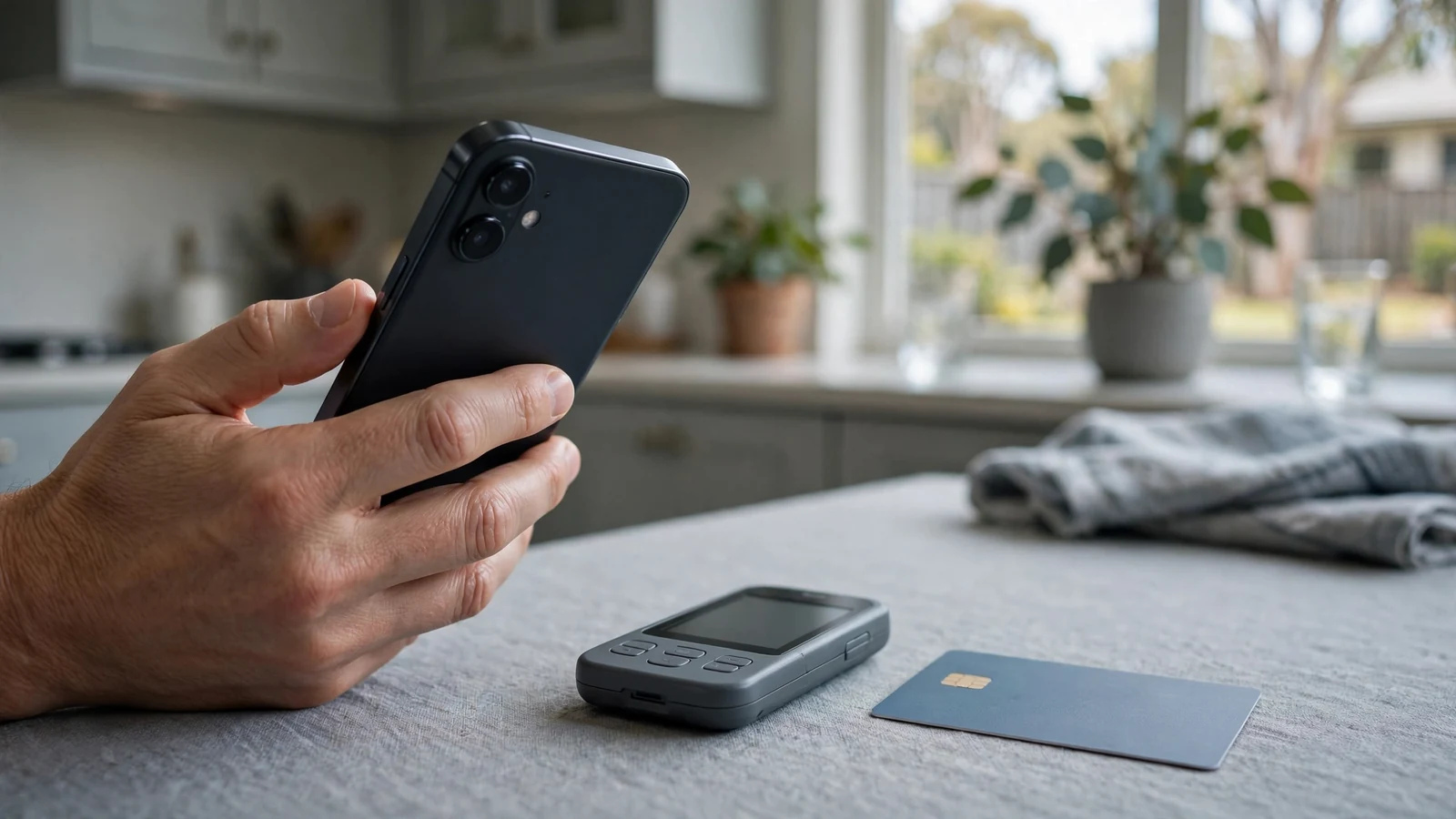
A phone can be the screen on which a payment is arranged without being the source of the money. In a PayID transaction, the movement begins inside the player’s banking app: the casino payment flow presents PayID, an amount is entered, and the payment is confirmed through the bank. The handset is the instrument of instruction. The bank account is where the funds come from.
That distinction matters in Australia, where the phrase “pay by phone” can suggest several quite different things. A mobile screen might be used to access a bank, a card, or a service that places a charge on a phone bill. Those are not interchangeable mechanisms. For the transaction described here, the sequence is narrower: select PayID in the payment flow, enter an amount, then approve the transfer in the banking app. The phone carries the instruction; the bank processes it.
The handoff between those screens is part of the experience. A person may begin on a casino deposit page, move to a banking app to authorise the payment, and then return to the first screen to see whether the deposit has appeared. The steps are brief, but they involve two systems: the payment interface that requests a deposit and the bank app that confirms it. A mobile device makes that passage possible without moving to a computer or a branch. It does not make the transaction a different kind of money.
PayID is connected to Australia’s New Payments Platform, which supports real-time transfers. Once a payment is released, the banking transfer can clear quickly; for casino deposits, arrival is reported within seconds, typically in the range of three to fifteen seconds. That timing describes the transfer’s pace, not a promise about every screen update or every account. A payment can move rapidly through the banking network while the receiving service still has its own process for showing the balance.
The speed changes the feel of the transaction. Older ideas of a bank payment often involve a pause: a form, a queue, a delay before the money becomes visible. A phone-based PayID transfer compresses the action into a few taps and a confirmation. The technology makes the payment seem almost conversational—request, authorise, receive—though the underlying act remains a transfer from a bank account. Fast is not the same as weightless.
The banking app’s confirmation step is especially important because it is where the account holder authorises the movement of funds. Before that point, choosing PayID and entering an amount have prepared a payment; they have not completed it. Confirmation is the decisive act. The process therefore depends not merely on having a phone nearby, but on being able to access the relevant banking app and approve the transaction there.
This also explains why a mobile device should not be mistaken for a payment provider. The phone displays the screens and carries the user’s instruction between them. PayID and the bank handle the transfer. The device itself is not a wallet simply because the whole process fits in one hand. In ordinary language, “paying on a phone” is an account of where the action happens, not necessarily of how the funds are collected.
The distinction has a particular weight in Australia. The Interactive Gambling Act 2001 makes it illegal for operators to provide real-money online casino games, including pokies and table games, to people physically located in the country. That legal setting is not altered by the speed or convenience of a payment rail. A description of how PayID works is not an endorsement of making a casino deposit, nor does a successful transfer establish that the underlying service is lawful.
In practical terms, the mobile sequence is simple to describe: a payment is initiated in a deposit flow, PayID is selected, an amount is entered, and the banking app is used to confirm it. The transfer may then reach the receiving account within seconds. The simplicity is technological, not legal. A small screen can make a substantial financial action look like a routine tap. It remains a bank payment, authorised by a person and governed by the rules that apply beyond the screen.
PayID Deposit Process
Initiation
A payment is initiated in the casino deposit flow.
Selection
PayID is selected as the payment method and the amount is entered.
Confirmation
The banking app is used to approve and confirm the transaction.
Completion
The transfer reaches the receiving account, typically within three to fifteen seconds.
The phone stays in the hand. The money leaves the bank.
A payment can reach its destination and still fail to become a usable account balance. The difference is often not the amount or the banking network, but the small piece of information that tells the receiving service whose deposit has arrived. In a PayID payment, that information may be the player’s account ID or username entered in the payment reference.
The reference works as a label attached to the transfer. A casino’s payment system can use it to connect an incoming payment with the right player account and credit the balance automatically. Without the requested identifier, the money may arrive without a clear match. The deposit can then sit pending until support staff investigate it and process it manually.
That is a quiet administrative failure, not necessarily a failed transfer. The funds may have moved while the account balance remains unchanged. From the player’s point of view, the distinction is frustratingly invisible: the bank records a completed payment, but the casino account does not show the corresponding credit. A correctly completed transfer is not always a correctly identified one.
This is why payment references are not decorative text. If a deposit instruction specifies a player ID or username, the reference field is part of the payment information, not an optional message. The exact identifier requested matters; a name that seems close enough may not be the value the system is set up to match. A missing or mistyped reference can turn an automatic process into a support case.
The reference should also be kept distinct from the amount. A deposit can meet a stated minimum and still need manual attention if its identifying detail is absent. Conversely, a correct reference does not make an amount acceptable when it falls below the stated threshold. These are separate checks: one associates the payment with an account, while the other determines whether the payment meets the deposit conditions.
PayID casino deposit minimums commonly begin in the AUD 10–20 range. Some services accept deposits as low as AUD 5 through bank transfer, but that lower figure belongs to a different route and should not be treated as the PayID minimum. The method selected therefore affects the amount that can be deposited, as well as the information needed to identify it.
These figures describe common thresholds, not a universal rule for every service. A displayed minimum is an operational condition, not evidence that a payment route is available or appropriate in every situation. Conditions can differ between operators and may change, so an amount remembered from an earlier deposit should not be assumed to apply elsewhere.
Small minimums have a social logic of their own. They lower the visible threshold for taking part, while the reference field preserves the institution’s need to sort each payment into an account. One detail makes entry seem easy; the other keeps the ledger orderly. The machinery is less casual than the amount suggests.
The phrase “pay by phone” can blur the distinction between the device used and the payment method itself. For a PayID deposit, the matching question is not whether a phone was involved, but whether the incoming payment carries the identifier the recipient needs. That is what determines whether a system can credit it without human intervention. The payment can be initiated on a mobile device and still require careful completion of the reference.
For Australian readers, there is also a legal boundary that sits outside the payment mechanics. The Interactive Gambling Act 2001 prohibits operators from supplying real-money online casino games to people located in Australia. A payment description cannot alter that rule, and a technically workable deposit process is not an endorsement or assurance of lawful access.
The practical lesson about matching is narrower: the account identifier and the deposit amount serve different purposes, and both can matter. An omitted identifier may leave a payment pending for manual handling; an amount below the stated minimum may not satisfy the deposit conditions. Neither issue is resolved merely because the bank shows that a transfer was sent.
A reference is a small field with an outsized job. When it is required, it turns a payment from an unexplained arrival into one that can be assigned to an account. Without it, the money may be there, but the matching still has to be done.
“Pay by phone” can describe two quite different things. One is a payment arranged on a mobile phone; the other is a charge placed on a phone account. The device is the same, but the route by which money moves is not. In Australia, PayID belongs to the first category: it is a bank-linked payment service, not a mobile-bill charge.
PayID operates through the New Payments Platform (NPP), the infrastructure used for real-time payments in Australia. Instead of relying on a bank account number, a payment can be addressed using an identifier such as a mobile number or email address. That identifier is connected to a bank account. It does not turn the mobile provider into the payment provider, or make the amount part of a phone bill.
The distinction matters because a search for a pay-by-phone casino can mean either “a casino payment made using a phone” or “a casino deposit collected through the mobile account.” Those are not interchangeable descriptions. A person may use a phone to access a banking service, while the funds still move through the banking system. The phone is the screen and the means of access; it is not necessarily the source of credit.
Treating the phrase “pay by phone” as proof of that arrangement would confuse a device with a payment method.
There is a further Australian distinction. The Interactive Gambling Act 2001 prohibits operators from supplying real-money online casino games to people located in Australia. The prohibition covers casino-style services such as pokies, poker and table games, rather than depending on whether a payment is made by bank, card or some other route. Advertising those online casino services to Australian audiences is also prohibited. Payment language cannot alter that legal position.
Legal Restriction
The Interactive Gambling Act 2001 makes it illegal for operators to provide real-money online casino games to people physically located in Australia.
That context makes the wording of payment claims especially consequential. A page describing “top casinos that pay by phone” may sound as if it identifies a recognised local category, but the phrase alone tells nothing reliable about the underlying transaction. It may refer to a bank payment initiated on a phone, or it may suggest billing through a mobile account. Without a clear description of the actual payment route, the two meanings blur together.
PayID’s identifier-based design can make a bank payment feel phone-native: a mobile number may serve as the identifier, and the service is available through banking systems built for real-time transfers. Yet the identifier is not a phone-bill account. It points to a payment service connected to banking, and the movement of funds belongs to that system. A familiar screen does not change the financial plumbing beneath it.
This is a small linguistic trap with a larger consequence. “By phone” names the instrument in ordinary speech, while “phone bill” names a different way of charging. In an online casino context, those words can be made to sound like a menu of available choices even where the underlying claim is unclear—and where the service itself sits outside the lawful offer to Australian residents.
So the phrase should be read narrowly. PayID is a bank-linked Australian payment service that can be used through a phone; that is not evidence of a mobile-carrier billing option. Similar wording does not make the mechanisms the same. The label travels more easily than the money.
When choosing a pay-by-phone casino in Australia for 2026, check the available details against what matters to you before deciding how to deposit. This list gives a brief reference to the information provided for each operator.
SpinsUp
SpinsUp is listed with a Curacao Gaming Control Board licence, OGL/2023/174/0082, held by Dama N.V.
Thor Casino
Thor Casino is listed under a Curacao licence through Antillephone N.V. (Versus Odds B.V.). Its stated minimum deposit is EUR 20.
Kingmaker
Kingmaker lists crypto payouts at around 90 minutes and fiat payouts at 1–5 days. Its stated minimum deposit is A$30.
MrPacho
MrPacho lists crypto payouts at 30–120 minutes and fiat payouts at 24–72 hours. Its stated minimum deposit is A$30.
Wild Tokyo
Wild Tokyo is listed as Curacao-licensed, with crypto payouts at 30–60 minutes and fiat payouts at 1–5 days. Its stated minimum deposit is A$10.
JeetCity Casino
JeetCity Casino is listed with a Curacao eGaming licence held by Dama N.V.
Roby Casino
Roby Casino is listed with a Curacao eGaming licence held by Roby Games Ltd.
Playfina Casino
Playfina Casino is listed with a Curacao eGaming licence held by Hollycorn N.V. since 2017. Its stated minimum deposit is A$20–30, depending on the offer.
Golden Pokies
Golden Pokies is listed as Curacao-licensed.
DragonSlots Casino
DragonSlots Casino is listed with a Curacao Gaming Authority licence held by Jumpman Gaming Ltd.
“Best” is often made to sound like a property of a casino: a badge, a table position, a confident adjective. For PayID, one useful measure sits elsewhere. The bank sets the transaction limit, and that limit can shape what a payment route can accommodate. It is not a rating of an operator, nor a promise about what any particular site will accept.
Most major Australian banks allow PayID transactions of AUD 1,000 to AUD 5,000 per transaction, with daily limits in the range of AUD 10,000 to AUD 20,000. Those are bank-side ceilings, not recommended gambling budgets and not casino deposit limits. A casino can set its own terms for payments; a bank’s capacity to send a transfer does not establish that a particular operator will accept it.
The distinction is easy to miss because payment language tends to collapse several separate decisions into one. A bank may permit a transfer of a given size; a recipient may impose a lower limit; and the customer’s own account settings may narrow the available amount further. “Best” therefore cannot be inferred from a large bank limit alone. It describes only one part of the chain.
The word also carries an uncomfortable ambiguity in Australia. Real-money online casino games, including pokies and table games, are prohibited services when offered to people physically in the country. A ranking of sites that supposedly accept such deposits would turn a banking detail into an endorsement of services operators cannot lawfully provide to Australians. The payment rail does not change that boundary.
There is still a practical meaning to comparing limits in the abstract. A person assessing a legitimate PayID transaction for another purpose can distinguish between a per-payment ceiling and a daily cap, and can confirm the bank’s own rules rather than assume that all institutions behave alike. The national ranges are broad, not uniform. Bank policy governs.
Bank Limits
Most major Australian banks allow PayID transactions of AUD 1,000 to AUD 5,000 per transaction, with daily limits between AUD 10,000 and AUD 20,000.
That is a more modest standard than a “best casino” label, but a more honest one. It measures the bank’s transfer capacity, not the quality or legality of a gambling service. Nor does a high ceiling make a transaction safer, more suitable, or more likely to be accepted by a recipient. It is simply room on the payment side of the ledger.
The old habit of ranking things is reassuring: one number, one winner, no troublesome distinctions. Banking does not oblige. Limits vary between banks, and the word “best” cannot turn an institutional setting into a universal verdict. The ceiling belongs to the bank. The rest belongs to a different question.
A “no wagering” label sounds like a promise that winnings can be withdrawn without first meeting play-through conditions. The label alone does not establish that. The written terms determine what an offer actually permits, and a promotion described as no-wagering still needs to be read for other restrictions on play, eligibility or cash-out.
A no-deposit bonus is a different claim: it suggests that a promotional benefit is available without an initial deposit. That wording does not confirm that an offer exists, who can receive it or whether winnings can be withdrawn. A bonus tied to a phone-based payment search is still a promotion, not evidence that a particular payment route or reward is available.
The small print is where broad promises become practical rules. Five conditions deserve particular attention:
These conditions are not interchangeable. A low wagering burden, for instance, would not settle what games count, whether a maximum bet applies or whether a cash-out ceiling restricts the result. A phrase such as “no wagering” cannot answer all of those questions by itself. The label is brief. The consequences may not be.
This distinction matters particularly in Australia. The Interactive Gambling Act 2001 prohibits operators from providing real-money online casino games, including pokies, poker and table games, to people located in the country. Advertising those services to Australian audiences is also prohibited. A bonus claim should therefore not be treated as an invitation or as confirmation that a real-money online casino offer is lawfully available to someone in Australia.
Terms associated with phone payments do not change the nature of a promotion. Nor does a reference to another country establish that the same offer applies in Australia. A country name in promotional wording says little about eligibility unless the applicable terms clearly identify who may take part—and it does not override Australian law.
The useful distinction is between a headline and its conditions: the headline names the attraction; the conditions define what happens to any bonus and resulting winnings. A claim that omits those details is not a reliable basis for judging the offer.
A payment label cannot establish whether an account is outside BetStop. Paying on a phone, using a bank-linked service or looking for a phone-bill option says nothing about a person’s status in relation to BetStop. Nor does the appearance of a payment route make an Australian real-money online casino service lawful: the Interactive Gambling Act 2001 prohibits operators from providing these games to people physically in Australia.
That distinction matters because payment searches often bundle together separate concerns: how money is deposited, whether a service is available, and what happens when winnings are requested. A phone-bill description does not itself confirm that a charge will be placed on a mobile account, or that a particular operator or payment provider is involved. The label is not a status check.
Withdrawal rules are a separate matter. A specialist review reports that an operator may ask for a withdrawal to return through the method used for the deposit, where that route is available. This is a conditional policy, not a guarantee that every deposit method supports cash-outs. The practical question is whether the operator’s stated withdrawal options match the route used to fund the account.
A specialist review also reports that identity checks are commonly required before a first withdrawal. Completing KYC verification before making a withdrawal request can reduce the chance that document requests interrupt the process. It does not promise approval or a particular processing time; it simply moves the paperwork away from the moment when a payout is being sought.
The documents and checks required can depend on the operator’s process. Until that process is complete, a withdrawal request may not be ready to proceed. A payment method cannot substitute for identity checks, and a quick deposit does not settle what happens at the withdrawal stage.
There is a broader Australian context here. Real-money online casino games, including pokies, are prohibited services when offered to people in Australia. So searches for a phone-bill casino “not on BetStop” should not be treated as evidence that a lawful local route exists, or that the payment method can determine someone’s BetStop status. Payment mechanics and legal status are different questions.
For any withdrawal process, the useful details are the operator’s stated rules: whether the deposit route can be reused, what KYC verification is required, and whether the account has completed it. The payment name alone answers none of these. A transfer can move money; it cannot certify an account’s status.
A payment label is not a catalogue. PayID describes a bank-linked way to move money; it does not say which games are available, whether a promotion exists, or what rules would govern one. Searches for pokies that can be funded by phone often collapse those separate questions into a single phrase. The phrase is tidier than the underlying arrangement.
There is also a legal boundary that matters in Australia. Under the Interactive Gambling Act 2001, operators are prohibited from providing real-money online casino games, including pokies, poker and table games, to people physically located in the country. A payment route cannot change that status. Nor does a casino-style bonus turn a prohibited service into a permissible one.
Promotional language can make the distinction harder to see. “Bonus” may suggest extra value, but the conditions determine what the offer actually permits. Before accepting any promotion, its wagering requirements, maximum bet limits, game weighting, time limits and maximum cash-out conditions all need to be read together. A generous-sounding headline can sit above rules that narrow how, when or whether the balance can be withdrawn. Small print is still part of the offer.
The same caution applies to claims about particular games or sites. A reference to PayID does not establish that a named title is offered, that a particular promotion is current, or that a site is available to Australians. A payment method is one piece of infrastructure, not evidence of a lawful game catalogue. The distinction is plain, if not always convenient.
That separation also helps explain why a search for casino games can return language about deposits and bonuses. Those are adjacent subjects, not interchangeable ones. A deposit method concerns the transfer; a game concerns the service being provided; a promotion adds its own terms. Treating them as one product can obscure the legal and financial conditions attached to each.
In Australia, the most important distinction is not between one set of pokies and another, but between payment language and the law governing the service. A phone may be part of a payment process. It does not make real-money online casino games available under Australian law. Nor should promotional wording be read as proof that an offer can be used. The machinery may be familiar. The boundary remains.
A bank wire is a different kind of online payment: rather than using a short identifier, it depends on the recipient’s banking particulars being entered correctly. To arrange a deposit, the payment form may ask for the casino business name, its bank account number and the bank’s name. Depending on the transfer, it may also request a SWIFT, BIC or IBAN code. These details identify the destination; they do not make the process immediate.
A wire can be arranged online from a computer or mobile device, but the transfer’s arrival is another matter. It may take as long as seven business days for the deposit to show in a casino account. The delay can make this route a poor fit when funds are expected to be available promptly. A phone may be the device used to set up the transfer; it does not turn a bank wire into a charge on a mobile account.
Cost is another consideration. Bank wires may carry charges higher than those associated with other non-banking transactions. The amount is not uniform, so the transfer’s stated fees matter as much as the recipient details. A payment that looks simple on screen can still involve time and cost beyond the act of sending it.
There is also a particular Australian context. Real-money online casino games, including pokies and table games, are prohibited interactive gambling services when offered to people in Australia. The mechanics of a bank wire do not alter that legal position. Describing the information a wire requires is not an endorsement of using it to fund an online casino account.
That distinction matters because payment language can blur separate things: a transfer made on a mobile device, a bank payment, and a charge added to a phone bill are not interchangeable. A bank wire belongs to the first two categories, with its own recipient details, processing delay and possible fees. It is not a shortcut around those limits. The machinery is ordinary; the destination is not thereby lawful.
A card can be a payment route without being a statement about where the money came from. Visa and Mastercard are described as widely accepted for deposits in a specialist review, but that does not establish that every operator accepts them, that a card can be used for a withdrawal, or that the arrangement is available to people in Australia. For card withdrawals, the processor matters: it may make them slower or may not support them at all.
That distinction is easily blurred by the word “credit”. A card payment describes how a transaction is processed; credit-funded gambling describes using borrowed money to gamble. The two ideas can overlap, but they are not interchangeable. A debit card, for instance, draws on a bank balance rather than a credit facility, while the card brand alone does not disclose the funding source. Nor does a deposit option tell anything reliable about the route for receiving money back.
Australia adds a more decisive boundary. Under the Interactive Gambling Act 2001, operators may not provide real-money online casino games, including slots, poker and table games, to people physically in Australia. The existence of a card network, or its acceptance elsewhere, does not make such a service lawful here. Payment infrastructure has no power to rewrite the rules.
For people reading about overseas services, the useful distinction is therefore modest but important: card deposits and card withdrawals are separate capabilities, and neither should be inferred from the presence of a Visa or Mastercard logo. A processor may handle one direction and not the other. A card may also be linked to funds that are not borrowed, despite the familiar name “credit card”.
The mechanism is not the permission.
“Free spins” and “bonus credit” describe promotional language, not proof that an offer is available or that it can be used in Australia. The word *free* can obscure the conditions attached: spins may be restricted to particular games, while any winnings may be subject to wagering requirements, maximum bet limits, game weighting, time limits or a maximum cash-out condition. The label alone says little about what can ultimately be withdrawn.
Credit wording needs similar care. It may refer to promotional funds rather than money deposited by a player, and it does not establish that a particular credit-based pokies offer exists. Nor does a payment made using a phone make promotional credit equivalent to a charge on a phone bill. The language of an offer should be read according to its stated terms, not treated as a description of the payment route.
There is a wider Australian context. The Interactive Gambling Act 2001 prohibits operators from providing real-money online casino games, including pokies, to people physically in Australia. Promotional phrasing does not change that legal position.
Where an offer is described, its conditions matter more than its headline. Wagering requirements, permitted bet sizes, game weighting, expiry limits and cash-out caps can each affect whether promotional value becomes withdrawable money. If those terms are unclear, the promise is unclear too. “Free” is not a condition.
Some casinos offer PayID withdrawals. Availability depends on the casino, and withdrawals may be subject to its approval process.
Minimum deposits commonly start at AUD 10–20, though some accept as little as AUD 5. Maximums depend on your bank: most major Australian banks allow AUD 1,000–5,000 per transaction, with daily limits of AUD 10,000–20,000.
PayID casino deposits commonly start at AUD 10–20, although some accept deposits as low as AUD 5.
PayID deposits typically arrive within 3–15 seconds once the payment is confirmed in your banking app.
Yes, some casinos offer PayID withdrawals. They typically have minimums of AUD 20–50, and the casino may need to review and approve the request first.
At top-rated PayID casinos, verified accounts’ requests are typically reviewed within 2–6 hours, and some are accepted within 0–6 hours. After approval, PayID withdrawals may arrive within minutes to hours; bank transfers and card withdrawals often take one to five business days.