Brisbane opening hours, gaming-floor availability, online legal limits and venue records answer different questions and need separate checks.
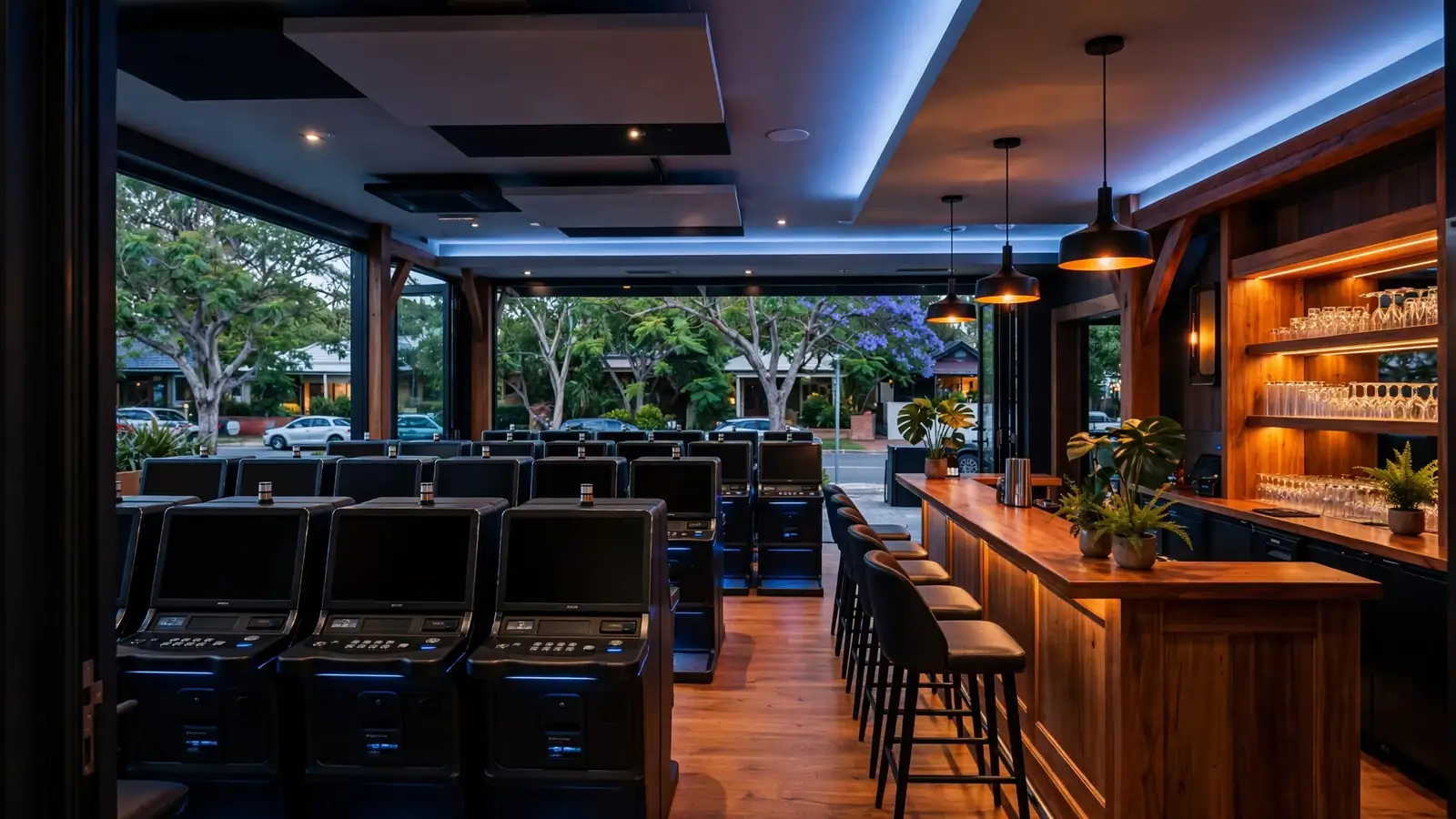
A venue’s doors being open does not establish that its pokies are available. The two details answer different questions: one concerns the venue’s trading hours, the other whether gaming machines are operating at that time. A late-night restaurant, hotel or club may remain open for food or other services while its gaming area is closed. Conversely, a venue may open earlier than its machines can operate. Neither arrangement can be inferred from the word “open” alone.
That distinction matters when checking whether pokies are open in Brisbane at a particular hour. Venue listings often compress a complicated day into a single label: open or closed. That label may describe the building, not every service inside it. A map result can be a useful first indication, but it is not a promise that the gaming floor is running. Hours can also change for public holidays, private functions or other operational reasons, and an old listing may persist long after the timetable has changed.
The more dependable check begins with the venue’s own current information. Its official website may give separate hours for the venue and its gaming area; if it does not, a direct call can resolve the distinction. The useful question is not simply whether the doors are open, but whether the pokies are operating at the intended time. A posted schedule is more informative than a general “open now” badge, and confirmation close to a planned visit is sensible when the timing matters.
Search results for early or late hours often turn on a small ambiguity. “Open at six” might mean the café opens, the bar begins service or the whole venue admits customers. It does not, without more detail, establish that pokies are operating from that moment. The same applies at night: a venue that stays open late does not thereby promise that its gaming machines continue to run until closing.
So an answer to “Are the pokies open now?” needs two checks. First, is the venue open? Second, are the machines operating? A current venue notice, a dedicated gaming-hours page or a direct confirmation is needed to answer both. If the information only gives general opening hours, the machine schedule remains unknown. That is not a technicality; it is the difference between a building’s timetable and a particular service’s timetable.
Brisbane-wide hours cannot sensibly be treated as one continuous schedule. Each venue sets and communicates its own operating information, and a city-level result cannot settle the position for every location. Even a page that accurately reports a venue’s ordinary hours may not reflect a temporary change. A listing should therefore be read as a lead, not as final confirmation, especially when the visit depends on a narrow window.
There is also a regulatory reason to keep the two clocks separate. A report by regionriverina.com.au describes a requirement taking effect from 1 July: venues with more than 20 gaming machines are to have a dedicated responsible gambling officer (RGO) on duty while those machines are operating. The report also says venues have a one-month grace period to remove signage and bring in the required officers. These details concern the period when machines are running, not simply the hours when a venue’s doors are unlocked.
The practical point is modest but important. Venue opening hours alone do not tell whether the machines are operating, and machine operating hours are the relevant context for the reported staffing requirement. A venue’s timetable may therefore list more than one set of hours, or it may require a phone call to clarify what the public-facing schedule leaves out. The rule does not turn every open hour into a gaming hour.
Nor does a venue’s late closing time establish round-the-clock access to pokies. “Open late” describes a possibility about the venue’s service hours, not a universal promise about gaming. The responsible way to read a timetable is literal: identify what the hours refer to, then confirm the separate machine schedule if that is the purpose of the visit.
A careful check can be brief: consult the venue’s own current information, look for a distinct gaming-hours entry, and contact the venue if the distinction is missing or the timing is important. General listings can help locate the relevant details, but they cannot reliably replace them. An “open” label is not a gaming-hours guarantee.
The distinction is ordinary, not obscure. Yet online listings often flatten it, because a single status is easier to display than the way a venue actually operates. For anyone checking whether Brisbane pokies are open now, the useful answer is therefore venue-specific and time-specific. Doors open. Machines may not.
Choosing pokies to play in Brisbane is easier when you can check the details that matter before signing up. This list offers a starting point for considering casino options in 2026.
SpinsUp
SpinsUp lists a Curacao Gaming Control Board licence, OGL/2023/174/0082, held by Dama N.V.
Thor Casino
Thor Casino lists a Curacao licence from Antillephone N.V. (Versus Odds B.V.) and a minimum deposit of EUR 20.
Kingmaker
Kingmaker lists a minimum deposit of A$30. Its stated payout times are around 90 minutes for crypto and 1–5 days for fiat.
MrPacho
MrPacho lists a minimum deposit of A$30. Its stated payout times are 30–120 minutes for crypto and 24–72 hours for fiat.
Wild Tokyo
Wild Tokyo lists a Curacao licence and a minimum deposit of A$10. Its stated payout times are 30–60 minutes for crypto and 1–5 days for fiat.
JeetCity Casino
JeetCity Casino lists a Curacao eGaming licence held by Dama N.V.
Roby Casino
Roby Casino lists a Curacao eGaming licence held by Roby Games Ltd.
Playfina Casino
Playfina Casino lists a Curacao eGaming licence held by Hollycorn N.V. since 2017. Its minimum deposit is A$20–30, depending on the offer.
Golden Pokies
Golden Pokies lists a Curacao licence.
DragonSlots Casino
DragonSlots Casino lists a Curacao Gaming Authority licence held by Jumpman Gaming Ltd.
“Best” sounds like a ranking, but pokies do not supply a stable order of winners. A spin is an independent event, determined by a Random Number Generator (RNG). The result of the previous spin does not make a particular result more or less due on the next one. A run of losses is not a signal that a win is approaching; a recent win does not make the next spin safer. The machine keeps no useful memory of a player’s fortunes.
That matters when a game is described as one of the best-paying pokies in Brisbane. The phrase can suggest that a particular title is more likely to pay out at a particular venue, or that recent results offer a reliable guide. Neither follows from a name or a short run of play. Even when a game has a stated return-to-player setting, that figure describes a theoretical return over a large number of plays, not a promise about an individual session. Randomness is less theatrical than a jackpot sign, but more relevant.
There is another complication: some game providers allow casinos to choose among different RTP settings for the same pokie. A specialist review has reported this possibility. It means that the title alone may not establish its return percentage; the same game could be configured differently at different casinos. A familiar name on a screen is therefore not, by itself, evidence that the machine has the same setting elsewhere.
The distinction is easy to miss because players tend to encounter games by their visible features: a theme, a bonus round, a sound, a name remembered from another venue. Those features can make two machines feel comparable. Their actual settings are a different matter. A comparison needs reliable information about the specific game and the setting in use, not merely a list of titles or a description of their features. Without that information, a confident ranking would dress uncertainty in the grammar of a table.
The same caution applies to claims about Brisbane CBD machines, city venues or a particular casino floor. A game’s presence in one place would not establish its configuration in another. Nor would a title’s popularity demonstrate that it pays more. Popularity may reflect familiarity, visibility or preference; it is not a measurement of return. A list of “best pokies in Brisbane” can be useful only if the basis for the word “best” is made clear and supported by information about the machines being compared.
There are several possible meanings, and they are not interchangeable. “Best” might refer to a player’s preferred theme or pace, to a feature they enjoy, or to a verified RTP setting. The first two are matters of taste. The last requires machine-specific evidence. Calling a pokie “best paying” without that evidence turns a personal impression into a claim about probability.
Some game providers allow casinos to choose among different RTP settings for the same pokie, meaning the same game could be configured differently at different casinos.
This is why the phrase “Brisbane casino pokies” can be less informative than it appears. It identifies a broad category, not a particular machine’s current setting or its future results. Even a confirmed setting would not predict what happens in the next session. An RTP is not a schedule of repayments, and no sequence of spins can be read as a dependable pattern. Independent events remain independent, even when a screen makes them feel like a story.
A careful comparison therefore has limits. It can distinguish verified information about settings from impressions about themes and past results. It cannot identify a guaranteed winner, infer a machine’s configuration from its title, or turn random outcomes into a dependable forecast. In the absence of verified game or machine data, no defensible ranking of specific pokies follows.
The word “best” can still describe preference. It cannot make chance behave.
A Brisbane venue and an online pokie may share a name in everyday conversation, but they sit on different sides of Australia’s gambling rules. A physical venue has machines on its premises. A real-money online casino is a service delivered over the internet, and the Interactive Gambling Act 2001 treats online casino-style games as prohibited when offered to people in Australia.
The distinction matters because there is no Australian-licensed online casino. The law makes it illegal for companies to provide real-money online pokies to Australians without a domestic licence, and none has been issued. So a page promising Brisbane casino online pokies is not describing a locally licensed counterpart to a venue in the city. The familiar language conceals a different arrangement: a service operated offshore, outside Australia’s system of casino licensing.
That legal line is directed at operators, not individual players. Australians are not made criminally liable merely for playing on an offshore site that accepts them. But the absence of player liability should not be mistaken for a domestic safeguard. A service may be reachable without being licensed here, and the ability to open an account does not create Australian oversight.
The distinction also puts claims about the best-paying pokies in Brisbane in perspective. A real-money game offered online is not a Brisbane machine simply because a website uses the city’s name or welcomes people in Queensland. Nor does an online label establish that the service is locally regulated. The location in the marketing is not the location of legal protection.
This is where the difference between access and recourse becomes stark. If an offshore casino refuses to pay winnings, Australian players have no legal recourse in Australia. That does not mean every dispute will end the same way; it means there is no Australian-licensed online casino framework to turn to for that kind of remedy. A balance displayed on a screen is not the same thing as a locally enforceable claim.
Online pokies near Brisbane can therefore mean something quite different from pokies in Brisbane, Australia. One phrase can point toward a physical venue; the other may point to a remote operator outside the domestic licensing system. Searches for cashless pokies in Brisbane or high-limit play do not change that legal status. Payment labels, game descriptions and familiar city names cannot turn an offshore online casino into an Australian-licensed one.
The word “cashless” adds another layer of ambiguity. At a physical venue, it may describe how a transaction is handled; on a website, it may describe an online payment route. Neither meaning establishes that real-money online casino play is licensed in Australia. The same applies to maximum-bet claims: an advertised feature says nothing, by itself, about the operator’s standing or the protection available if a dispute arises.
Legal Recourse
There is no Australian-licensed online casino; if an offshore site refuses to pay winnings, Australian players have no legal recourse in Australia.
This is not a claim that every online service disappears from view. Offshore sites may accept Australians, and people can play on them without the law imposing liability on the player. Yet access is not endorsement, and a site’s willingness to take a customer does not supply a local licensing regime. The legal burden sits with the operator; the practical risk of an unpaid win can still sit with the player.
The line is plain, even when the language is not. Brisbane has physical venues; Australia has no licensed online casino. An offshore site may be accessible, but if it withholds winnings, Australian legal recourse is absent. The screen does not make it local.
A venue’s reputation is often compressed into a single word: “best”. That word can suggest atmosphere, service or a favourite machine, but it says little about how a venue responds when gambling stops looking like leisure. Responsible-gambling oversight is less photogenic than a gaming floor. It is also more revealing about the obligations attached to operating one.
A report published by regionriverina.com.au describes a requirement taking effect from 1 July: venues with more than 20 gaming machines are to have a dedicated responsible gambling officer (RGO) present while those machines are operating. The threshold matters. The description does not make the staffing requirement universal across every venue, and it does not turn an officer’s presence into a verdict on the quality of a particular Brisbane location.
The role places a named responsibility on the venue during machine operation. That is a different kind of measure from a general promise to support responsible gambling: it connects oversight to the period when the machines are in use. In practical terms, the officer is part of the venue’s operating arrangements, not a badge that can be inferred from a listing or from the appearance of the room.
The same report describes a further record-keeping obligation: venues are to maintain a gambling incident register. It is intended to capture details of relevant occurrences, including situations in which a patron’s behaviour indicates possible risk of, or existing harm from, gambling. The register turns an encounter that might otherwise remain an informal staff observation into something recorded as an incident.
That distinction matters. A record does not itself prevent harm, and its existence cannot establish how a venue handles every difficult moment. But recording such events gives the venue a formal account of what has been noticed. The emphasis falls not only on the individual patron, but also on whether the venue has a process for recognising and documenting signs of trouble.
For people comparing Brisbane venues, these safeguards belong in a different category from the usual shorthand of location, décor or machine choice. They concern the responsibilities of the operator and the systems around gambling activity. A venue cannot be judged from a name alone; nor does a claim about oversight amount to evidence of an individual venue’s conduct.
The register is not a rating. The officer is not a guarantee. Both are signs of a more demanding idea of venue responsibility: one that asks operators to assign attention and preserve a record when gambling harm may be emerging. Quiet paperwork, with consequences.
A Brisbane search for pokies can lead from physical venues to questions about online deposits, including whether a bonus is available without putting money in first. These are different matters. A payment method describes how a transaction is attempted; it does not establish that an online casino is licensed to serve people in Australia, or that its games are fair.
There is no Australian-licensed online casino. Under the Interactive Gambling Act 2001, operators cannot provide real-money online casino games to people in Australia without a domestic licence, and none have been issued. A deposit page, a familiar payment logo or a promise of a no-deposit bonus does not change that legal position. Nor does the ease of making a transfer verify how a site handles play or withdrawals.
Payment blocks add another layer of uncertainty. A specialist review reports that Australian banks and card companies are increasingly blocking transactions to gambling sites they identify. A declined payment may therefore reflect a bank or card issuer’s restrictions, rather than a technical fault at the merchant. The reverse is no proof either: a payment that goes through says nothing about the operator’s legal standing.
Card deposits carry a separate cost risk. A specialist review reports that a bank or card issuer may classify a gambling transaction made with a credit or debit card as a cash advance. In that case, fees of 3–5% and interest charged immediately may apply, depending on the issuer’s treatment of the transaction. The relevant terms are those of the bank or card issuer, not the wording on a casino’s deposit screen. A page that presents a payment as quick or straightforward cannot settle how it will appear on a statement.
That distinction matters when online offers are framed around playing for real money or receiving spins without a deposit. An offer concerns the operator’s terms; it does not create Australian licensing or provide an Australian route for resolving a dispute. If an offshore casino refuses to pay winnings, Australian players have no legal recourse in Australia. A payment facility is not a regulator.
For Brisbane residents, the word “pokies” can refer to machines at a physical venue or to online games presented as casino products. Search results may place those meanings side by side, but the payment details belong to the online transaction, not to a local venue. Even a technically successful deposit cannot bridge that difference.
A useful reading of any payment claim is therefore narrow: it can describe a proposed way to move money, and perhaps the costs a bank may attach to it. It cannot establish that a site is lawful for Australian residents, that its games are fair, or that a promised bonus is a dependable benefit. The distinction is less exciting than a deposit button. It is more consequential.
A map can answer a narrow question: what places appear close to a chosen point? It cannot, by itself, establish what happens inside them. A result described as near Brisbane’s CBD, near the airport or simply nearby may be useful for orientation, but proximity is not proof that a venue has pokies. Nor does a pin settle whether the information is current or whether the place suits the purpose of the search.
Attention: A map result showing a venue is "nearby" does not guarantee the presence of pokies or that the listing information is current.
That distinction matters because “near” is elastic. A result can be close by road but awkward to reach on foot; a straight-line distance can ignore transport routes, access points and the shape of the surrounding area. Around an airport, the chosen starting point matters too: a terminal, an airport boundary and a nearby road are not interchangeable reference points. The map’s neat dot is a simplification, not a travel plan.
Search wording can make the same task seem more precise than it is. Someone looking for pokies near the Brisbane CBD may be trying to find a venue within walking distance, while someone searching around Brisbane Airport may mean somewhere accessible during a stop or after arriving. Those are different location questions. A search result that answers one loosely may not answer the other at all.
The useful distinction is between a lead and a verified detail. A listing can suggest a venue’s location; it does not necessarily confirm the presence of gaming machines. A business description may be broad, outdated or focused on other services. Before treating a result as evidence, the venue’s own current information is the more relevant place to check. Even then, location and machine availability remain separate matters.
“Near me” adds another complication: it depends on the position used by the device or service. If that position is imprecise, the displayed results may be imprecise as well. Searches mentioning Brisbane can also include places beyond the area someone has in mind, while a search mentioning a different Brisbane can refer to another locality altogether. The place name narrows the field; it does not define the boundary.
There is a simple legal threshold behind any in-person gambling search. In Australia, the minimum age for gambling is 18. A location result cannot establish that someone meets that requirement, and being close to a venue changes nothing about it.
Maps are good at placing things. They are less good at proving what those things contain. That is the modest, useful limit of a proximity search.
A venue’s opening time and the hours when its pokies are operating are not the same thing. A building may be open while machines are switched off; a listing that says “open now” therefore does not establish that play is available at that moment. Nor does the phrase “24-hour venue” prove that pokies run without interruption. Hours can only be understood as separate pieces of information, not folded into one reassuring label.
That distinction matters in Brisbane, where a search for round-the-clock play can produce a stronger impression than the available wording warrants. A venue’s own current information may describe its general trading hours, while the status of its gaming floor is a separate question. The two should not be treated as interchangeable. Open doors are not a timetable for machines.
There is also a staffing rule tied specifically to machine operation. A report published by regionriverina.com.au says that, from 1 July, venues with more than 20 gaming machines are required to have a dedicated Responsible gambling officer (RGO) on duty whenever those machines are operating. The trigger is not simply that the venue is open: it is the operation of the machines. The report does not turn that obligation into a promise that every venue is open all night, or that its machines are available at every hour.
A report by regionriverina.com.au states that from 1 July, venues with more than 20 gaming machines must have a dedicated responsible gambling officer (RGO) on duty whenever those machines are operating.
The presence of an RGO is an operational safeguard, not a signal of a particular schedule. It tells something about who must be on duty under the stated rule when a qualifying venue’s machines are running. It does not settle when a particular Brisbane gaming floor opens, closes, or pauses operation. A staffing requirement is not an opening-hours notice.
The practical result is plain, if less tidy than a single search result. Venue hours describe access to the premises; machine hours describe access to play; the RGO requirement concerns staffing during machine operation at venues above the stated threshold. Each answers a different question. A claim of continuous availability needs to refer to the machines themselves, not merely the building or a broad label attached to it.
“Open now” is only half an answer.
South Brisbane and South Bank are often treated as one destination in casual conversation, though a map gives them distinct boundaries and a river between them. The same shorthand appears in searches for pokies: a suburb or precinct is made to stand in for a particular venue. Place names can narrow a journey; they cannot establish what a venue offers. Nor does a result for North Brisbane or the Northside describe the southern precincts.
The more useful distinction is between a venue’s size and the obligations that apply to its gaming floor. A report by regionriverina.com.au says that, from 1 July, venues operating more than 20 gaming machines must have a dedicated Responsible gambling officer (RGO) on duty while those machines are running. The threshold matters: the requirement is tied to the number of machines, and the officer’s presence to their operation. It is not a blanket description of every venue in South Brisbane, South Bank, or elsewhere.
That is a particular kind of public safeguard. A person on duty is meant to make responsible-gambling oversight part of venue operations, rather than leave it as a slogan on a wall. Yet the rule does not turn a neighbourhood into a guarantee, and a street address alone does not reveal whether a specific venue falls within the threshold. Geography is a beginning, not a credential.
Searches for a maximum cash payout at Brisbane pokies raise a different question. A machine’s payout arrangements are not established by its location or by the presence of an RGO. Those are separate matters, and a suburb name cannot settle either one. A large jackpot figure, if displayed in promotional material, would not by itself explain the conditions attached to a payout.
There is a social history in this effort to make gambling safer through staffing rules. The venue remains a business, but the state asks certain operators to place a named responsibility on the floor while machines are active. That is more concrete than a general appeal to play responsibly, though it does not erase the tension between entertainment and harm. The map remains a map. The duty is operational.
A search for pokies in Brisbane’s CBD clubs can make the machines seem like the whole story: where they are, what is available, which venue looks preferable. But the more revealing question is how a venue responds when gambling stops looking like ordinary recreation. A machine cannot answer that. People working in the venue can notice behaviour that suggests harm, and the records kept by the venue make that concern part of its formal operations.
A formal record maintained by venues to capture details of occurrences where a patron's behaviour indicates a possible risk of, or existing harm from, gambling.
A report by regionriverina.com.au says venues will be required to maintain a gambling incident register. The register is intended to capture details of occurrences, including situations in which a patron’s behaviour indicates they may be at risk of gambling harm or already affected by it. That is a specific record-keeping duty, not a public rating of a club and not evidence that one venue is safer than another.
The distinction matters. A list of CBD clubs with gaming machines would describe places; an incident register concerns what happens inside them. It creates a record of an event that might otherwise remain only a brief exchange between a patron and staff. The requirement also reflects a view of gambling harm as something a venue has a role in recognising, rather than a private matter invisible to the institution earning from the machines.
A register cannot, by itself, establish how often harm occurs or whether a venue handles every situation well. Nor does its existence make a club suitable for every person. It is a record, not a verdict. For anyone considering self-exclusion, the register should not be mistaken for a substitute for a formal exclusion process; its stated purpose is to document gambling-related incidents.
That changes what “best” can sensibly mean in a CBD club context. A venue’s machines may attract attention, but a search result cannot show how staff respond to signs of harm or how a particular incident is recorded. The register requirement offers a narrower, more concrete point: venues are expected to document occurrences that raise concern. The paperwork matters because it turns an uneasy observation into something the institution is obliged to retain.
Not a recommendation.
A Crown-branded search can make a Brisbane venue seem settled before the underlying claim has been checked. The name may appear in a headline, directory entry, map result or discussion, but repetition is not confirmation. It does not establish that a Crown casino operates in Brisbane, that a particular venue has a pokies room, or that any machines there are available to the public.
Those are separate claims. A venue’s existence and identity would need reliable, current confirmation; the presence of pokies would need confirmation about that venue specifically. A broad reference to Crown cannot bridge either gap. Nor does a page about Crown elsewhere establish a Brisbane connection. Search systems gather language and links, not proof.
The same caution applies to requests for the best pokies room in Brisbane. A branded name cannot support a comparison of rooms, machines or facilities unless the places being compared have first been verified and the comparison rests on relevant evidence. Without that groundwork, a ranking would turn an unconfirmed premise into a recommendation. Neat, but not reliable.
For a claim about a physical venue, the useful distinction is between a page that merely repeats a name and information issued by the venue or an appropriate authority that identifies the location and its facilities. Even then, the details should match the precise claim being made: confirmation of a venue is not automatically confirmation of its gaming facilities, and confirmation of facilities does not establish that every machine is operating at a particular time.
Brisbane wording attached to Crown may also reflect a mistaken association, an outdated reference or an unrelated use of the name. Those possibilities are not findings about any particular result; they are reasons not to treat a label as evidence. The responsible account is narrower: searches may mention Crown alongside Brisbane, but that wording alone cannot verify a Crown casino there or establish what pokies, if any, are present.
This is a limit on what can be said, not a verdict on every result bearing the name. A location claim requires location-specific evidence. Until that is available, Crown-branded wording should not be used to describe a Brisbane venue as confirmed, or to promise a pokies room that has not been established.
Yes, Australians can play on offshore sites that accept them, but offering real-money online pokies to Australian residents without a domestic licence is illegal. No Australian-licensed online casino exists, and players have no legal recourse in Australia if an offshore casino refuses to pay.
You must be at least 18 years old to gamble online in Australia.
No strategy can predict or improve the result of the next spin: each spin is an independent random event. A previous win or losing streak does not make a particular result more likely.
It is the amount you must bet to meet a bonus’s turnover condition before withdrawing winnings. For example, a $500 bonus with a 40× requirement calls for $20,000 in bets; if the requirement applies to a $500 deposit plus a $500 bonus at 35×, it calls for $35,000 in bets.