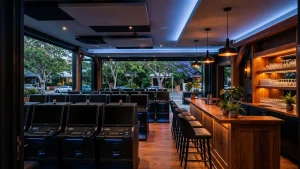
Perth searches can point to venues, but current access, machine comparisons and payment options require separate consideration.

“Open now” sounds like a simple status: doors open, machines available, visit possible. In practice, it compresses several questions into one. Is the venue open to the public at this moment? Is the area with pokies operating? Has anything changed since the published information was last updated? A search result can suggest where to look, but it cannot settle each point on a venue’s behalf.
That distinction matters in Perth, where an immediate plan may depend on a particular time of day. Someone looking for an early start, a late visit or somewhere open at the moment is not asking for a general description of a venue. They need information tied to the present, and present-tense information ages quickly. Opening details read earlier may no longer describe the situation at the door.
The sensible first step is to check the venue’s own current information. If the status remains unclear, contact the venue directly before setting out. This is less elegant than a single green “open” label, but it puts the answer with the people responsible for the premises rather than with a directory trying to summarise them. An online listing can be useful as a starting point; it should not be mistaken for confirmation.
There is also a difference between a venue being open and pokies being available. A building may have public areas operating while a particular part of it is not accessible, or the information presented online may describe the venue in broad terms rather than the machines. The point is not to assume that such a distinction applies at any named Perth venue. It is to avoid treating one status as proof of the other. When the visit depends specifically on pokies, the question to verify is whether that part of the venue is operating at the intended time.
Searches for pokies open now in Perth, or for machines available early or late, express a momentary need. They do not establish a schedule. Nor does a phrase such as “open” promise continuous access throughout the day. The result may be based on information that is general, incomplete or no longer current; a fresh confirmation is more useful than the confident appearance of a listing.
There is a small social history inside this habit. People once planned a visit around a venue’s printed notice, a call or the knowledge of someone who had been there. Now the same practical uncertainty is dressed as a live status on a screen. The technology makes the answer look immediate; the underlying fact still belongs to the venue. A label is not a key.
Time matters especially when a trip is being made for one purpose. A venue’s broad opening information may not answer whether pokies are operating at the precise point of arrival. Asking that question directly can prevent a wasted journey, without assuming that every venue follows the same pattern or that any particular Perth location keeps the same hours as another. Local schedules are not interchangeable.
The wording “open now” also has a short shelf life. A result seen before leaving may not reflect a later arrival, and a status that is accurate at one moment cannot guarantee the next. That is not a reason to distrust every listing. It is a reason to treat it as a snapshot rather than a promise, particularly when the trip is time-sensitive.
Opening information answers only an access question. It does not tell whether a pokie is more likely to pay, what its return setting is, or whether one machine is preferable to another. Those are separate matters, and the venue’s doors being open cannot settle them. Keeping these questions apart makes the immediate decision clearer: first establish whether the relevant venue and gaming area are operating; do not infer anything further from that answer.
For an early-morning visit, a late-night stop or an unplanned trip across town, the most reliable wording is plain: check with the venue for the time in question. No universal Perth timetable can be read into a search phrase, and “open now” is not a standing guarantee. The status belongs to a place, at a moment. Verify that moment.
When looking for pokies options in Perth for 2026, it helps to check the operator details available before deciding where to play. This list gives a concise reference to each operator’s stated licensing, deposit or payout information.
SpinsUp
SpinsUp lists a Curacao Gaming Control Board licence, OGL/2023/174/0082, held by Dama N.V.
Thor Casino
Thor Casino lists a Curacao licence through Antillephone N.V. (Versus Odds B.V.) and a minimum deposit of EUR 20.
Kingmaker
Kingmaker lists crypto payouts at around 90 minutes and fiat payouts in 1–5 days. Its minimum deposit is A$30.
MrPacho
MrPacho lists crypto payout times of 30–120 minutes and fiat payout times of 24–72 hours. The minimum deposit is A$30.
Wild Tokyo
Wild Tokyo lists a Curacao licence, crypto payouts in 30–60 minutes and fiat payouts in 1–5 days. Its minimum deposit is A$10.
JeetCity Casino
JeetCity Casino lists a Curacao eGaming licence held by Dama N.V.
Roby Casino
Roby Casino lists a Curacao eGaming licence held by Roby Games Ltd.
Playfina Casino
Playfina Casino lists a Curacao eGaming licence held by Hollycorn N.V., dating from 2017. Its minimum deposit is A$20–30, depending on the offer.
Golden Pokies
Golden Pokies lists a Curacao licence; no deposit or payout details are provided here.
DragonSlots Casino
DragonSlots Casino lists a Curacao Gaming Authority licence held by Jumpman Gaming Ltd.
“Best” is a small word carrying several different expectations. It might mean a game with an appealing theme, one that is easy to understand, or one a venue is known for offering. But when the phrase means “most likely to pay”, appearance and reputation cannot do the work of evidence. A lively screen is not a forecast, and a Perth venue’s name cannot tell anyone what a particular machine will return.
The distinction matters because a pokie does not remember what happened before. Its Random Number Generator determines each spin separately, so a run of losses does not make a win due, and a recent win does not make another one more likely. Patterns that feel persuasive to a person watching the reels are not instructions from the machine. Randomness is indifferent to a good story.
That is why “best-paying pokies in Perth” is not a dependable category on its own. A ranking would need comparable, reliable information about the games and the settings in which they are offered. A game’s popularity, its familiar artwork or a venue’s reputation supplies none of that. Nor does a confident claim become a measurement simply because it is repeated.
A pokie's Random Number Generator determines each spin separately, meaning past results do not influence future outcomes or make a win due.
There is a further complication: the same named game may not have one universal return setting. A specialist review reports that some game providers give casinos a choice of multiple RTP settings for a pokie. If a casino selects among those settings, the same game could carry different return percentages at different venues. The game title alone, then, may not settle the comparison.
RTP—return to player—is a percentage describing a theoretical return across a very large volume of play, not a promise about an individual session. It cannot predict the result of the next spin or specify how much a particular person will receive. Even where a setting is documented, it describes the game’s long-run mathematical behaviour, not a personal outcome. The distinction between a theoretical rate and a single evening is not a technicality. It is the whole point.
This leaves a modest way to read claims about the best pokies in Perth: ask what “best” is meant to measure, and what evidence supports that measure. If the claim concerns theme or presentation, that is a matter of taste. If it concerns return, a venue name or game title is not enough; the relevant setting would need to be established for that game at that venue. Without comparable information, a ranked list risks giving precision to what is only preference.
The same caution applies to talk of casino pokies in Perth or machines in the CBD. Location can identify where a game is found; it cannot establish how it performs. A collection of player anecdotes may describe memorable wins, but memorable outcomes are not a controlled comparison. People tend to tell the story that stands out. The quiet majority of ordinary spins makes a poorer tale.
None of this means every game is identical in presentation, or that preferences are pointless. It means those preferences should not be mistaken for a reliable method of choosing a winner. A game may be entertaining to one person and tedious to another; that judgement belongs to the player. A claim about which game pays best belongs to evidence, and evidence has to match the precise game and setting being discussed.
For a search framed around the best pokies in Perth in 2026, the honest answer is therefore narrower than a list of supposed champions. The word “best” can describe a preference; it cannot make randomness predictable.
A venue is more than the room in which pokies happen to sit. It is also the place where responsibility has to become visible: in staffing, in decisions made when play appears to be causing harm, and in records that let an incident be treated as more than an impression. That practical layer is separate from the behaviour of any individual machine.
A report published by regionriverina.com.au describes a requirement for venues with more than 20 gaming machines to have a dedicated responsible gambling officer (RGO) on duty while the machines are operating, from 1 July. The report also describes a one-month grace period for venues to remove signage and introduce those officers. These are details of a reported measure, not a basis for assuming that every Perth venue has the same arrangement. A threshold is not a venue directory.
The same report describes a gambling incident register: a record of occurrences that includes situations in which a patron’s behaviour suggests they may be at risk of, or affected by, gambling harm. The point of such a register is institutional memory. Without a record, a troubling episode can vanish into the next shift, leaving staff to rely on recollection and a patron’s distress to begin again from zero. With one, the venue has a way to document what happened and recognise that responsibility does not end when the immediate exchange does.
That is a different kind of question from which Perth venue might be called “best”. A reputation, a polished room or a convenient location cannot stand in for the less visible arrangements around machine operation. Nor does a record itself prove that every response is effective. It shows that an incident can be formally recognised and retained, rather than treated as a private misunderstanding between a customer and an employee.
For someone comparing Perth venues, the useful distinction is between what can be observed and what should not be inferred. A venue’s public-facing amenities may be easy to describe; its internal handling of risk is harder to judge from a brief visit. The presence of a responsible gambling officer, where required, gives that role a defined place in the operation of the room. An incident register gives events a place in the venue’s account of itself. Neither is a promise about outcomes. Both make accountability less dependent on memory.
The records matter because gambling harm rarely arrives with a neat label attached. Staff may see behaviour that raises concern, but a single observation is not the same as a conclusion about a person. A register can preserve the occurrence without pretending to settle every interpretation. That is a modest function, but a necessary one: institutions cannot respond consistently to events they do not record.
The search for Perth pokies venues often compresses several concerns into one phrase: where machines are found, what a venue is like, and whether it takes responsibility seriously. Those are not interchangeable. Venue oversight concerns the people and procedures surrounding play; it does not certify a machine’s performance or establish a ranking. The paperwork is not glamorous. It is still part of the room.
Venues with more than 20 gaming machines are reported to require a dedicated responsible gambling officer on duty and the maintenance of a gambling incident register.
A location can make a venue sound close before it has made anything clear. “Near Perth Airport” may describe a broad search area rather than a particular address; “near the CBD” has the same looseness in a different direction. Neither phrase establishes how far a venue is from a terminal, a central street or the place where someone happens to be standing.
That distinction matters because proximity is not a single measurement. A venue may look close on a map yet sit on the other side of a road network, a railway line or a route that takes longer than the straight-line distance suggests. A pin can mark a business entrance, a car park or the middle of a large property. The small map symbol carries very little of that information.
Airport wording is especially elastic. A search for pokies around Perth Airport can gather places associated with the airport district, rather than places inside the terminal or immediately beside it. The distinction between “at the airport” and “near the airport” is ordinary language doing more work than it can safely bear. An airport name in a result is not proof of access from the terminal.
Nor does a result labelled “in Perth” settle the matter. Perth is both a city name and a word that can appear in other place names or regional references. Add Victoria, Parkes or North Perth to the wording and the intended geography becomes more specific, but the phrase still needs to be matched to an actual address. A location label is a clue, not a route.
The same caution applies to Perth Central and the CBD. “Central” can suggest an area without defining its boundary; “CBD” can stand for a district, a transport destination or simply a convenient description. For a venue that matters because it is near a particular hotel, station or workplace, the useful question is not whether a listing uses a central-sounding label. It is where the entrance sits in relation to that particular point.
A practical comparison begins with the exact venue address, then checks the route from the intended starting place. Driving distance, walking distance and public-transport travel are different measures. So are a map’s estimated journey and the time it takes at the moment of travel. None can be substituted for another just because a result appears near the top of a list.
There is a small social history in the phrase “near me”. It turns the phone into a local directory and makes location feel settled: the device knows where the person is, so the result seems to know what “near” means. But the word hides a choice. Near by distance? By travel time? By the route someone can actually take? A search engine can return options; it cannot decide which of those meanings matters.
For Perth Airport, the CBD, North Perth or another named locality, the address is the anchor. The result’s wording is only a label attached to it. That is less dramatic than a promise of convenience, but more useful. A pin is not a journey.
Labels like "near Perth Airport" or "near the CBD" are broad search terms. A venue may appear close on a map but be separated by road networks, railway lines, or routes that increase actual travel time.
A request for Crown Perth pokies sounds precise: one named venue, one kind of entertainment, and an implied chance to compare what is available there with other places in Perth. But a name does not settle the practical questions hidden inside it. It does not establish which machines are operating, what room they are in, what rules apply to a particular machine, or how a cash payout is handled. Those details cannot be supplied by the venue name alone.
That distinction matters because casino language often compresses several different things into one phrase. “Best pokies room” might mean a room someone finds comfortable, a particular selection of games, or a belief that larger prizes are more attainable there. These are not interchangeable measures. A room’s reputation cannot, by itself, substantiate a claim about machine performance or cash payouts. A confident ranking can make a vague impression look like a tested result. It is still an impression.
Nor does a Crown Perth comparison become reliable simply because the venue is named. A useful comparison would need clear criteria and current, specific information about the features being compared. Without those, calling one room the best is less a finding than a label. The word carries authority more easily than evidence.
The same caution applies to questions about the maximum cash payout on a pokie at Crown Perth. “Maximum” may sound like one simple figure, but a meaningful answer would have to identify what is being measured and which machine or terms it concerns. A broad claim about the venue cannot safely stand in for those particulars. No figure should be inferred from a general description, a rumour, or a headline stripped of its conditions.
This is not an argument that a named venue cannot be compared. It is an argument about what a comparison must show. Claims about available games, room characteristics, or payout arrangements need to be tied to specific and current information. Otherwise, the comparison invites a reader to treat a general impression as if it described every machine and every visit. That is a familiar trick of consumer language: the definite article makes a complicated place sound uniform.
The name Crown Perth can identify the subject of an enquiry; it cannot answer that enquiry on its own. A venue’s reputation, the appeal of a room, and the terms attached to a particular machine are separate matters. Keeping them separate is less dramatic than a top pick, but it is more honest.
There is a broader social habit at work here. People often ask for a single “best” place because a ranking promises to turn uncertainty into a decision. The promise is attractive; the evidence may not be there. In gambling, that gap deserves particular care, since confident language can suggest an advantage where none has been established. A polished comparison is not the same thing as a verified one.
So a Crown Perth-specific answer should remain narrow unless it can substantiate more: the venue is the subject, not proof of its machines’ features or performance. A room can be described only with information that actually concerns that room; a payout claim needs its own terms. Without those distinctions, “best” and “maximum” are merely persuasive words. Not measurements.
The appeal of playing from home can make an online pokie seem like a simple extension of a Perth venue. Legally, the distinction is substantial. The Interactive Gambling Act 2001 prohibits companies from providing real-money online casino games, including pokies, to people in Australia. No Australian licence for an online casino has been issued. There is no domestic licensed online casino behind an offer of real-money play.
That boundary concerns the operator. It does not make an individual player criminally liable simply for using an offshore site that accepts Australian customers. But the absence of player liability is not approval of the service, nor does it turn an offshore operator into an Australian one. A website may be reachable and still be operating outside the Australian legal framework. Access is not legitimacy.
The distinction can get lost in searches for online pokies around Perth, or for a casino game that promises real-money play without a deposit. Offers can make the transaction look familiar: an account, a balance, a button to withdraw. Familiarity is a poor substitute for a local legal safeguard. The law addresses the company supplying the service; it does not create an Australian system to enforce an offshore company’s promises to its customers.
That is where the practical risk becomes sharp. If an offshore casino refuses to pay winnings, an Australian player has no legal recourse in Australia to compel payment. A displayed balance is not the same thing as money in hand, and a dispute with a business beyond the domestic licensing system does not acquire an Australian remedy merely because the customer is in Perth. The interface may look settled. The protection is not.
Nor do labels such as “best paying”, “high limit” or “maximum bet” change the legal position. They describe what a promotion or site claims to offer, not whether the operator is authorised to provide real-money online pokies in Australia. A bonus can be a lure; it cannot supply a licence. The wording of an offer is not a regulator.
Australia’s approach is notably directed at the supply of the service rather than the individual who plays. That can sound like a narrow technical distinction, but it leaves a conspicuous gap between personal exposure and consumer protection: the player may not be the target of the law, while still being left without an Australian route to recover withheld winnings. A quiet gap.
BetStop, the national self-exclusion register, applies to Australian-licensed operators; it does not bind offshore sites. It should not be mistaken for a safeguard that travels with an account across borders. The same caution applies to identity checks: identity and address documents should be verified before a first withdrawal is pursued, but providing documents does not establish that an offshore operator is licensed or that a payment dispute can be resolved in Australia.
The legal boundary, then, is not a promise that every reachable site is safe, nor a claim that players face the same liability as operators. It is a division between prohibited supply and individual liability—and a reminder that, when an offshore service withholds winnings, Australian legal remedies do not fill the space.
A request for a Perth venue that stays open around the clock expresses a clear wish: access without having to plan around a closing time. It does not establish that such access exists. A phrase in a listing, an old review or a result labelled “open” is not a venue’s current operating schedule.
Attention: A venue being open does not guarantee that the specific pokie area is operating; always verify the status of the gaming area directly.
Opening times are practical details, but they are not permanent facts. A venue’s public hours may differ from the hours of a particular area or service, and schedules can change. Even a venue described as open for twenty-four hours would need to confirm what that means for its pokie area. The distinction matters: a building being accessible does not, by itself, prove that every facility inside it is available at all times.
This is less a technicality than a reminder about how convenience is advertised. “Always open” sounds like a property of a place, almost as fixed as its address. In practice, it is a claim about an operating arrangement, one that belongs to the venue and can be checked only against the venue’s own current information. A search result cannot make that arrangement binding.
The same caution applies to Perth pokie opening hours more generally. A page may remain online after details have changed; a map listing may show general venue hours rather than machine access. Neither should be treated as a guarantee of late-night or continuous play. Where plans depend on a particular time, direct confirmation from the venue is more useful than an assumption drawn from a label.
There is also a difference between “open now” and open without interruption. The first describes a moment; the second makes a broader promise about the schedule. One does not prove the other. A venue operating late on one occasion, or appearing open at the time a result is viewed, says little about what will happen later or on another day.
The phrase “24-hour pokies in Perth” should therefore be read as a request, not a verified description of local access. No venue schedule follows from the wording alone. The hours remain the venue’s to state—and to change. A clock is not a roster.
The words “Perth CBD clubs” point towards a type of place, not a confirmed list of venues or a guarantee about what any club offers. The same caution applies to expectations about pokies in the city centre: a location label cannot establish a machine’s presence, its settings or the conditions of play. A club’s name may sound like a promise of a particular experience. It is only a name.
Limits are less picturesque, but more useful. Deposit limits can put a boundary around money transferred for play; loss limits can define a point at which losses stop; session time limits can interrupt the quiet stretching of one visit into another. These are standard responsible-gambling tools, not predictions about how a session will go. A limit does not make a game less random, nor does it turn a loss into a recoverable investment. It marks a boundary before the moment when changing course can feel hardest.
Self-exclusion serves a different purpose. Rather than setting terms for continued play, it is an option for stepping away. In Australia, BetStop applies to Australian-licensed operators; it does not bind offshore sites. That distinction matters because an exclusion tool is only as broad as the services required to honour it. No single setting should be mistaken for a universal barrier.
Responsible gambling tools include deposit limits, loss limits, and session time limits, as well as self-exclusion options like BetStop for Australian-licensed operators.
There is a social history in the language of limits. Gambling has often been treated as a private test of restraint, as though every difficult session were simply a failure of character. Yet the existence of deposit, loss and time controls recognises something more ordinary: people can lose track of money and time in environments designed around repeated play. A safeguard does not settle the argument about responsibility. It does acknowledge that self-command is not an endlessly renewable resource.
For anyone weighing up a club visit, the useful question is not which CBD label sounds most persuasive. It is whether there are clear ways to set boundaries, take a break or exclude oneself, and whether those controls fit the kind of gambling involved. A limit is not a guarantee of safety. It is a line drawn before the room begins to blur it.
Perth belongs to Western Australia; South Australia is a different state, not an alternative label for the city. The two place names can become tangled in the same search, especially when someone is looking for pokies while travelling or comparing Australian locations. That overlap does not make the rules or venues of one state a guide to the other.
The national framework is the steadier point of reference. The Australian Communications and Media Authority (ACMA) enforces the Interactive Gambling Act 2001, the law governing prohibited interactive gambling services in Australia. State and territory settings can shape venue operations, but a broad phrase about South Australian pokies does not establish what a particular venue offers, when it operates or what local conditions apply. A place name is not a licence to fill in the rest.
There is also a national threshold that does not change with the map: the legal age for gambling in Australia, including online pokies, is 18. That rule applies whether the location in mind is Perth, elsewhere in Western Australia or South Australia. Geography can redirect a journey; it does not lower the age bar.
For a Perth-focused choice, South Australia is best treated as a detour in the wording, not evidence about Perth venues. Keeping the states distinct prevents a familiar category error: assuming that a result attached to one place tells the same story about another. Australian regulation is layered, and the state named matters. So does the difference between a venue question and a national law.
Cashless play at a Perth venue and PayID belong to different parts of the transaction. Cashless play describes how money is accessed or handled at a venue; PayID is a way to transfer money between bank accounts. Treating the two as interchangeable makes a payment feature sound like a description of the pokies themselves. It is not.
PayID works as an alias layer over Australia’s New Payments Platform (NPP). A transfer can be directed using an email address, mobile number or ABN rather than the recipient’s bank details. The NPP is supported by all major banks and protects transfers with end-to-end encryption. Those are properties of the payment infrastructure, not a certificate for every business or service that might mention PayID.
The distinction matters because a familiar payment method proves very little about what sits behind a transaction. PayID support does not establish that an online gambling site is licensed in Australia, nor does it show that a pokie’s return settings are disclosed. Real-money online casinos are not licensed in Australia; a bank transfer mechanism cannot change that legal position. Payment plumbing is not oversight.
At a physical venue, cashless arrangements are a separate question about how play is funded or recorded. The word “cashless” alone does not identify a venue’s systems, the machines available or their operation. Those details need to be established at venue level, not inferred from the label.
Newcastle and Perth are also separate places, not a combined venue description. Geography resists abbreviation. Payment terminology does too.
Yes, Australians can legally play on offshore sites that accept them, but offering real-money online pokies to Australians without a domestic licence is illegal for operators. No Australian online casino licences have been issued, and players have no legal recourse in Australia if an offshore casino withholds winnings.
Yes, PayID is treated like any other qualifying deposit method at the recommended sites, so eligible deposits can qualify for bonuses.
Yes. Some providers let casinos choose from multiple RTP settings for a game, so the same pokie can have different return percentages at different casinos.