Australian law distinguishes international casino platforms from locally licensed services, while table formats, betting rules and payment options vary.
In Australia, the phrase “online casino” describes a market that exists in conversation and on screens, but not as a locally licensed form of gambling. The distinction matters. A platform may accept Australian players without being an Australian-licensed casino, and the presence of a baccarat table does not change the legal category of the service.
The Interactive Gambling Act 2001 prohibits operators from providing real-money online casino games to people physically located in Australia. Baccarat falls within that broader category of casino table games. The rule concerns the provision of the service: Australian-licensed operators cannot offer online casino games, and there are no locally licensed online casinos officially operating in the country.
That leaves an unusual gap between the language of everyday use and the legal structure. Australians search for live dealer baccarat, speak of playing baccarat online, and may encounter international casino platforms that accept Australian players. Yet those platforms are not local casinos operating under an Australian online casino licence. A familiar game and a familiar interface can make the arrangement feel ordinary. Legally, it is not.
The law is directed at companies providing prohibited interactive gambling services to people in Australia. The Interactive Gambling Act does not make an individual player criminally liable merely for using an offshore casino. That distinction is important, though it does not turn the service into a lawful Australian offering or remove the risks surrounding it.
The framework reflects a particular public judgement: online casino gambling is not to be supplied as a licensed domestic industry. It is not a system in which local casinos may apply for permission, meet local standards and then offer online baccarat. The line is drawn earlier, at provision itself. The result is a market with no locally licensed online casino sector, rather than a regulated field of local competitors.
The statute also reaches beyond baccarat. Online casino-style services such as poker, blackjack, roulette and slots are treated as prohibited interactive gambling when supplied to customers in Australia. Baccarat is therefore not an isolated exception, nor does the live-dealer format place it outside the rules. The format may look more like a table in a room; the service remains online casino gambling.
There is a dry institutional logic to the arrangement. A game can travel across a screen more easily than its legal status can travel with it.
Australians nevertheless play baccarat online through international casino platforms that accept players from the country. The existence of that activity should not be confused with official local operation. An overseas platform does not become Australian-licensed simply because its site is accessible, its language is familiar, or it describes a table as available to Australians.
Nor does the phrase “live baccarat casino” settle the matter. It may describe a product offered by an international operator, not a domestic venue authorised to provide online casino games. Search results and marketing language tend to flatten these distinctions; law does not. Where a platform is based and licensed elsewhere, its overseas status is central, not incidental.
Australia actively blocks and enforces against offshore online casino services. That enforcement setting complicates the idea of a stable, openly available market. International platforms may accept Australian players, while access to offshore services is also subject to blocking. The two facts sit uneasily together, as policy and technology often do: one describes the legal and enforcement position, the other the continuing behaviour of people who play.
This is why “baccarat online casino Australia” can sound like a request for a conventional local product when no such licensed category exists. The phrase names a player’s intended activity, not a locally authorised industry. A person may encounter an international service, but that encounter is not evidence that Australia has approved the operator to provide online casino gambling here.
Legal Prohibition
The Interactive Gambling Act 2001 prohibits operators from providing real-money online casino games to people physically located in Australia. There are no locally licensed online casinos officially operating in the country.
The legal position should not be softened into a routine checklist about choosing a licence. There is no Australian online casino licence for a baccarat operator to hold. A foreign licence, where one exists, is not an Australian authorisation. Nor does the absence of player liability amount to government endorsement, protection or a guarantee that a platform will remain available.
That separation leaves practical and financial uncertainty around international services. The Australian framework does not convert them into local providers, and the fact that Australians use them does not erase the prohibition on supplying online casino games to people in the country. Lawful local gambling categories and prohibited online casino services are not interchangeable simply because both involve money and chance.
The legal landscape, then, is not a list of Australian baccarat casinos. It is a boundary: domestic operators cannot provide online casino games, no local online casinos officially operate, and some Australians still use international platforms. Understanding that boundary is the necessary context for any discussion of online baccarat in Australia in 2026. It is context, not endorsement.
18+ only. Gambling can cause financial harm. Goldenbet-hub-au.com is not liable for losses incurred through gambling.
Choosing a live baccarat casino is easier when you can check the available operator details before deciding where to play. Use this list as a reference, and verify that the casino suits your needs in Australia.
SpinsUp
SpinsUp is listed with a Curacao Gaming Control Board licence, OGL/2023/174/0082, held by Dama N.V.
Thor Casino
Thor Casino is licensed through Antillephone N.V. for Versus Odds B.V. Its stated minimum deposit is EUR 20.
Kingmaker
Kingmaker lists a minimum deposit of A$30. Its stated payout times are around 90 minutes for crypto and 1–5 days for fiat.
MrPacho
MrPacho lists a minimum deposit of A$30. Its stated payout times are 30–120 minutes for crypto and 24–72 hours for fiat.
Wild Tokyo
Wild Tokyo is listed as Curacao-licensed, with a minimum deposit of A$10. Its stated payout times are 30–60 minutes for crypto and 1–5 days for fiat.
JeetCity Casino
JeetCity Casino is listed with a Curacao eGaming licence held by Dama N.V.
Roby Casino
Roby Casino is listed with a Curacao eGaming licence held by Roby Games Ltd.
Playfina Casino
Playfina Casino is listed with a Curacao eGaming licence held by Hollycorn N.V. since 2017. Its stated minimum deposit is A$20–30, depending on the offer.
Golden Pokies
Golden Pokies is listed as Curacao-licensed.
DragonSlots Casino
DragonSlots Casino is listed with a Curacao Gaming Authority licence held by Jumpman Gaming Ltd.
“Best” is an awkward word in a market where Australian-licensed operators cannot offer online casino games. It can suggest a dependable local choice, when no such casino operates under an Australian online-casino licence. Offshore platforms are a different matter: their presence in discussions of baccarat does not make them locally licensed or turn comparison into an endorsement.
That distinction matters because a list of supposedly superior casinos can make a commercial claim look like a neutral assessment. A more useful approach is to consider what the advertised terms mean, while keeping the legal status of the service in view. A polished lobby is not evidence of Australian authorisation. Nor does a familiar payment option establish that an operator is approved to provide online casino games in Australia.
An account displayed in Australian dollars can make the stated balance easier to understand. It also avoids the currency-conversion margin applied to balances held in US dollars or euros: the reported margin is between 2.5% and 4%. That difference affects the value represented by a balance before any game is considered. A figure that appears unchanged on screen can carry a cost when money moves between currencies.
The denomination alone says little about the rest of an account’s conditions. A balance shown in Australian dollars does not establish how withdrawals are handled, whether a payment method is available for both deposits and withdrawals, or what restrictions apply. Those terms should be read as part of the same financial picture, not treated as fine print separate from the headline balance.
This is not a question of which table looks liveliest. It is a question of what the numbers attached to an account actually describe, and whether they remain meaningful once conversion and withdrawal conditions are considered.
A specialist review reports weekly withdrawal caps of $5,000–$10,000 at offshore sites. That is a reported range, not a guarantee that any particular platform uses those limits, and not a settled description of every operator. A cap can affect how quickly funds above it become available; the wording of the rule matters as much as the amount.
The term “weekly” also needs to be read in the operator’s own conditions. A limit might be described by a calendar period or another schedule, and the page setting out the rule is more useful than a banner promising easy withdrawals. The relevant details are the cap, how the period is defined, and whether separate conditions apply to a particular account or payment route.
Withdrawal Limits
Reported weekly withdrawal caps at offshore sites typically range from $5,000 to $10,000, though specific limits depend on the operator's own conditions.
These are comparison points, not proof of reliability. A stated ceiling does not establish that a withdrawal will be approved, and a larger cap does not make a service safer or lawful for Australian customers. Numbers can be precise while the larger picture remains unresolved.
The phrase “best baccarat casino online” compresses several different ideas into one: currency treatment, withdrawal conditions, legal status and the claims made in promotional material. Those ideas should not be collapsed into a single score. A platform that quotes an Australian-dollar balance may still impose conditions elsewhere; a published withdrawal cap does not settle questions about its status in Australia.
The same caution applies to phrases such as “best online casino for baccarat”. They sound like consumer guidance, but a ranking can lend authority to a service without establishing that it is locally authorised. In Australia, no locally licensed online casino officially operates. That fact cannot be repaired by a comparison table, a familiar interface or a payment option presented in local currency.
So the sensible meaning of “best” here is not a recommendation. It is a demand for clear terms—and an awareness that clear terms do not, by themselves, make an offshore casino an authorised Australian service. Gambling can cause financial loss. Goldenbet-hub-au.com is not liable for losses arising from gambling. 18+ only. If gambling is causing harm, support is available through gambling-help services.
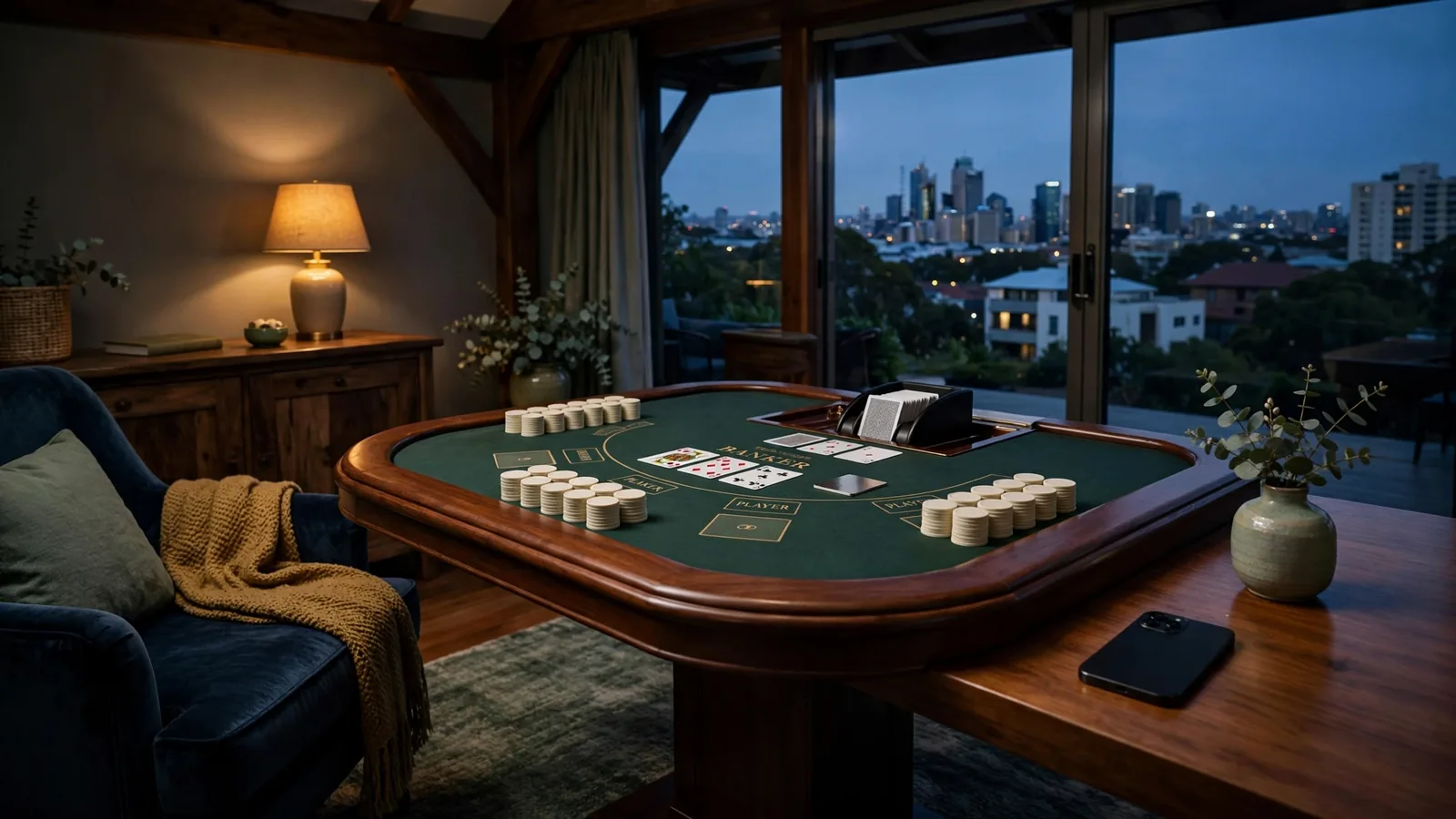
A live dealer baccarat table is a studio made visible through a camera. The dealer sits at a physical table, handles real cards and conducts the game while a stream carries the scene to a virtual table on screen. The setting is neither a drawing of a casino nor a sequence of animated outcomes. It is a broadcast of people and objects, arranged to make a distant viewer feel briefly present.
That small change in distance matters. Cards have edges, hands move across felt, and the dealer’s gestures give the proceedings a human rhythm. A camera can show the action; it cannot turn a remote viewer into someone seated in the room. The experience is social in appearance, mediated in fact.
The dealer’s role is more than decoration. They manage the physical cards and guide the pace of the table, while prompts on screen indicate when betting is open and when the next stage begins. The viewer follows both channels: the studio image and the interface laid over it. One belongs to the room; the other belongs to the software translating that room into a usable online session.
This arrangement borrows from the older theatre of casino play. A table game has always depended on more than its rules: there is the dealer’s composure, the ceremonial handling of cards, the pause before a result. The camera preserves some of that formality, though the studio is built for transmission rather than for a crowd gathered around the felt. It is theatre with a very practical control panel.
At some tables, a chat function may let players exchange messages with the dealer or with one another. A specialist review describes this as an available feature, not a fixed part of every live table; the room may feel conversational in one session and almost silent in another. Chat adds a social layer, but it does not erase the basic arrangement: people are watching the same broadcast from separate places, and the dealer remains the one person physically present with the cards.
The dealer manages physical cards, guides the pace of the table, and provides a human rhythm to the game. Their actions are broadcast via camera, creating a mediated social experience for remote viewers.
That distinction helps explain the appeal. The stream offers visible human action where a screen-based interface might otherwise feel abstract. It also makes the experience dependent on the camera’s view and the studio’s conduct. A card must be visible; a gesture must be legible; the feed must carry the moment clearly enough for remote participants to follow. The machinery is not absent. It is simply kept behind the curtain.
Live dealer games are often offered only for real-money play, according to a specialist review, so a practice mode may not be available at a particular table. This is a consequential feature of the format, not a reason to treat the broadcast as harmless entertainment. Gambling can cause financial loss, and Goldenbet-hub-au.com is not liable for losses arising from gambling. For adults aged 18 and over only; gambling should be approached responsibly.
In Australia, the legal setting is also material: the Interactive Gambling Act 2001 prohibits operators from providing real-money online casino games to people in the country. The presence of a polished studio stream does not alter that rule. A camera can make a distant table feel close. It cannot change the law.
A baccarat game can look much the same on the betting screen while being produced in two quite different ways. International platforms offer both live dealer baccarat and RNG baccarat, but the distinction is not merely a matter of graphics. It is the difference between a streamed table and a result generated by software.
In live dealer baccarat, a professional dealer handles physical cards at a studio table, with the proceedings sent to players as a video stream. The cards, dealing and pace belong to the filmed event. The screen carries the table into a remote setting, but it does not turn the cards into illustrations: what appears is a dealer handling a real shoe.
RNG baccarat, by contrast, has no live cards or dealer whose actions determine the hand. Algorithm-based software produces the outcomes. The interface may still show familiar table imagery and the same broad choices, but the visual resemblance should not be mistaken for a shared process. One format records a human-run table; the other calculates results electronically.
That difference changes the atmosphere more than the underlying premise. Both are versions of baccarat, and both present the game through a screen. Yet the live format puts a visible human performance between the wager and its result, while RNG baccarat removes that intermediary. In one, the camera shows cards being dealt; in the other, the software supplies the result. The distinction is plain, even when the interface tries to make it disappear.
A separate variation changes how a winning Banker bet is paid. In standard baccarat, the usual treatment of a winning Banker wager includes a commission. No Commission Baccarat removes that charge, but the title does not mean every Banker win necessarily receives an unchanged payout. A specialist review describes versions in which the return can instead be adjusted for certain Banker totals.
That adjustment matters because a rule can move rather than erase a cost. A table may advertise the absence of commission, while its rules set a different payout for particular results. The label alone is therefore not a full account of the arrangement. The written table rules determine what happens to a winning Banker bet, including whether a special total receives a reduced return.
Outcomes are determined by a professional dealer handling physical cards in a studio, broadcast via video stream.
Results are generated electronically by algorithm-based software without the use of physical cards or a live dealer.
A variation where the standard commission on winning Banker bets is removed, though payouts may be adjusted for certain totals.
The format and the rule variation are separate questions. RNG baccarat describes how outcomes are generated; No Commission Baccarat describes a way of handling certain Banker payouts. A live table may use one set of payout rules, and a software-based game may present another. The name of the format does not establish the payment terms, and the name of the variation does not say whether a dealer or algorithm produces the hand. Two labels, two different jobs.
For Australian readers, this distinction is descriptive rather than an invitation to play: the Interactive Gambling Act 2001 prohibits operators from providing real-money online casino games to people physically in Australia. The presence of an online baccarat format does not change that legal position.
The quiet lesson is that a familiar table image can conceal a different mechanism, and a reassuring rule name can conceal a different payout. The screen is not the rules.
18+ only. Gambling can cause financial loss. Goldenbet-hub-au.com is not liable for gambling losses.
Access to live dealer baccarat involves two separate questions: how a platform handles deposits and whether its table can be viewed on a mobile device. Neither answer is universal. Payment options and device support depend on the service, and a payment method appearing in a summary does not establish that it is lawful or available for online gambling in Australia.
Australian payment-method overviews name PayID, bank transfers, e-wallets and cryptocurrency, alongside Visa and Mastercard. That list describes methods reported in specialist reviews, not an invitation to use them for gambling. Credit cards must not be accepted for online gambling services. The distinction matters: a method’s familiarity in everyday commerce does not make it an authorised route into a casino service.
PayID is often associated with quick bank-to-bank transfers, but its presence in a payment list says little about the conditions attached to a particular service. Bank transfers and e-wallets have their own account requirements; cryptocurrency introduces a different kind of transaction altogether. The practical detail is not simply which logo appears on a deposit screen, but whether a method is permitted, what the terms say, and how the service treats the funds. Names alone are not safeguards.
The old casino cashier was a physical counter, a place where money changed hands under the watch of staff and house rules. Its online descendant is less visible: a sequence of account screens and payment instructions. The interface can make that process seem ordinary. The law does not become ordinary with it.
A specialist review reports that live dealer baccarat can be accessed on Android and iOS devices. On a phone or tablet, the live table is presented through a stream and its accompanying controls; the screen is smaller, but the basic format remains recognisable. Whether a particular device works well depends on the service and its software, so mobile support should not be inferred merely from the existence of an app or a website.
Mobile access also changes the setting. A table once associated with a formal room can appear amid the scattered intervals of daily life: a commute, a pause, an evening on the sofa. The technology makes the setting portable; it does not make the stakes less real. The convenience is not neutral.
Attention: Mobile accessibility and a polished interface do not establish that a service is lawfully authorised to provide online casino games in Australia.
A device can therefore answer only the technical part of the question. It may display a live table, but that is separate from whether the service may lawfully provide online casino games to people in Australia. The distinction is easy to blur when the same screen contains the stream, the account and the payment controls. A polished interface cannot settle the legal question.
18+ only. Gambling can cause financial harm. Gambling involves financial risk, and Goldenbet-hub-au.com is not liable for losses. If gambling is causing harm, support is available through local gambling-help services.
A table’s minimum stake, speed and maximum limit shape the experience more directly than its label. A “standard” table may leave room to follow each hand at an unhurried pace; a Speed table compresses the intervals between decisions. VIP tables sit at the other end of the scale, where the ceiling matters more than the name on the felt.
The figures available for these conditions are snapshots, not permanent features of the market. A specialist review reports minimum stakes of $5–$10 per hand at live baccarat tables, while $1 tables are described as uncommon. Those amounts are useful as a point of comparison, not a promise that every lobby will show the same options. Table limits can vary between games and can change, so the posted terms matter more than a broad description of a site.
Pace is another practical distinction. A specialist review estimates around 40–50 hands an hour for standard live baccarat, compared with more than 80 at Speed tables. The difference is not merely a quicker stream: more hands leave less time between decisions. A measured pace may suit someone who wants to watch the table unfold; a faster one can make a session feel markedly more compressed. Neither format improves the underlying wager.
The top limit deserves equal attention, even when it is unlikely to be relevant to most players. A specialist review notes that some VIP baccarat tables may set limits as high as A$20,000 per bet. That is an upper-end feature reported for some tables, not a general limit or an invitation to treat a large ceiling as a benefit. A table can be unsuitable because its minimum is too high, just as easily as because its maximum is low.
A useful comparison therefore starts with the range shown for the specific table: minimum, maximum and pace. A title such as “VIP” says little on its own; the posted limit says more. Likewise, “Speed” describes tempo, not a different baccarat strategy. The felt may be virtual, but the time pressure is quite real.
For anyone trying to compare baccarat casino sites, table conditions are a more concrete measure than a “best” label. The available minimum determines whether a table fits a chosen budget; the pace indicates how quickly that budget may be exposed to repeated decisions. A high ceiling adds no value to a player who has no reason to approach it. A number is not a recommendation.
18+ only. Gambling can cause financial harm. Goldenbet-hub-au.com is not liable for losses.
In live dealer baccarat, the house edge gives a clearer comparison between the main wagers than a bonus headline does. The stated edge is 1.06% on Banker and 1.24% on Player. For Tie, it rises to 14.36%. These percentages describe the casino’s mathematical advantage over repeated play, not a prediction of what will happen in any particular hand. A short run can depart sharply from the arithmetic.
The difference between Banker and Player is narrow; the gap between either of them and Tie is not. A tie wager can look tempting because it concerns an outcome with a distinct payoff, but its much higher house edge makes it the costlier choice in the long-run calculation. The table may present all three options with equal visual prominence. Mathematics does not.
A baccarat casino bonus adds a separate calculation. Its value depends not only on the headline offer, but on the terms attached to it: which games count, how much each wager contributes, and what conditions apply before any winnings can be withdrawn. A specialist review reports live baccarat contribution toward wagering requirements in a range of 5–15%. That is a reported range, not a universal term; the operator’s own bonus rules determine the treatment of a particular offer.
This matters because a live game can count for less than its stake when wagering progress is calculated. A bonus that appears generous may therefore require substantially more play than its headline suggests. If the contribution rate is low, baccarat may be an inefficient way to meet the requirement. The printed terms, rather than the promotional label, carry the useful information.
The same arithmetic applies whether a balance is funded with ordinary currency or cryptocurrency. Bitcoin does not alter the house edge on Banker, Player or Tie, and it does not make bonus conditions disappear. Payment method and game odds are separate questions.
For a simple comparison, the Banker wager has the lowest stated house edge, Player is close behind, and Tie is far higher. Bonus terms can change the practical cost of play, but not those underlying figures. No offer removes the risk of losing money.
18+ only. Gambling can cause financial harm. Goldenbet-hub-au.com is not liable for gambling losses. If gambling is causing harm, stop and seek support.
A baccarat scoreboard can look like a private shorthand: marks arranged in columns, repeated colours, runs that seem to invite interpretation. Its first purpose is simpler. It records what has happened at the table, while the cards explain how each hand reached its total. The display is a record, not a forecast.
The arithmetic is designed to keep totals compact. Picture cards count as zero. When a hand’s total passes ten, the digit on the left is discarded: the remaining digit is the score. A total above ten therefore does not behave like a running sum in ordinary arithmetic. The scoreboard makes more sense once that small difference is clear.
That is the useful key. Baccarat cards are not read as a conventional pile whose growing value keeps climbing; the displayed score turns on the final digit. A hand can contain cards whose combined value looks larger than its recorded total, but there is no contradiction. The left-hand digit has simply been dropped.
The deal may also continue after the opening cards. If a hand totals under five, another card is dealt. That rule makes the scoreboard a trace of a process, rather than just a pair of final numbers: an additional card can alter the route to the displayed result. The total shown is still the part that matters for reading the record.
Reading the Score
Identify the Total
Sum the cards, but if the total passes ten, discard the digit on the left (e.g., 15 becomes 5).
Apply Card Values
Treat all picture cards as zero when calculating the hand's total.
Check for Additional Cards
Determine if a third card was dealt (typically if a hand totals under five) to understand the final recorded result.
It is tempting to search the board for a pattern with predictive force. Repetition is easy to notice; evidence of what comes next is another matter. The marks describe completed hands, not a promise about the next one. In that respect, the scoreboard resembles many human records: orderly enough to invite a story, but not obliged to confirm it.
For anyone looking at a casino baccarat scoreboard, the practical task is modest: follow the recorded result, then use the card total to understand it. Picture cards contribute nothing; a total over ten loses its leading digit; a low total may bring another card. Once those points are in view, the board becomes less cryptic. No prophecy required.
A live table is not simply a game that waits in a browser until someone arrives. Its availability can depend on the studio schedule, and a table shown in a lobby may not be open at every hour. A specialist review notes that scheduled access can be restricted; the practical consequence is that a listing alone does not establish when play is available. The stated timetable is the useful detail.
That matters especially for live dealer baccarat, where the streamed table has a finite number of player places. A baccarat casino site may present several tables in its lobby, but a seat at one is still part of a shared, real-time arrangement. The lobby is less a row of doors than a noticeboard: it can show what is scheduled without promising immediate access.
Trial play has a similar constraint. A specialist review describes trial access as possible but limited, because places at live tables are finite and occupied by players. This is a different condition from trying software that runs without a live table. Where access depends on a seat, a free mode may not be available on the same terms—or at all. The distinction is practical, not mysterious.
The phrase “mini baccarat” can also create an expectation of a separate room or a reliably available trial table. The label by itself says nothing about the schedule or whether a seat is open. Availability remains a matter of the particular table’s posted hours and access conditions, rather than a promise attached to the game’s name.
In Australia, these access details do not change the legal position: real-money online casino games are prohibited for operators serving people in the country. This section is informational, not an invitation to use an offshore service. 18+ only. Gambling can cause financial harm; Goldenbet-hub-au.com is not liable for losses.
Baccarat’s central choice is unusually spare: Banker, Player or Tie. These are the three possible outcomes on the table, and a wager names the side expected to prevail—or predicts that neither side will. The names can suggest a contest between people, but they label the two hands, not the dealer and a customer.
The rule beneath those choices is a race towards nine. The hand with the total nearer to nine wins. If the two hands finish level, the result is a tie. That is the whole shape of the decision: choose an outcome before the deal, then see which hand comes closest to the target.
The simplicity has its own history of sorts. Casino games often dress a small decision in ceremony; baccarat reduces the wager to three labels and lets the ritual gather around them. The dealer manages the hand, while the players’ choices remain fixed once betting closes. No elaborate strategy is needed to understand what each side means, though understanding the wager does not remove chance from the result.
These basic baccarat rules are the same whether described as casino baccarat rules or simply as the choices at a table: Banker, Player or Tie, with the nearest hand to nine taking the win. The names are plain. The outcome is not.
18+ only. Gambling can be harmful and carries a risk of financial loss. Goldenbet-hub-au.com is not liable for losses incurred through gambling.
Yes. International platforms that accept Australian players offer live baccarat, streamed from a studio with a real dealer and physical cards.
Australian-licensed operators cannot provide online casino games, including baccarat, and no locally licensed online casinos officially operate. The law targets providers; it does not make an individual player criminally liable merely for using an offshore casino.
A live dealer deals physical cards at a virtual table, with the game streamed from a studio. Players bet on the Banker, Player or Tie; the hand closest to nine wins.
Bet on the Banker or Player hand that you think will finish closest to nine; you can also bet on a Tie. The winning side is the one with a total closest to nine.
The Banker bet has the lower house edge in live baccarat: 1.06%, compared with 1.24% for the Player bet. The Tie bet has a much higher house edge of 14.36%.