Plinko’s peg-and-prize format may resemble a pokie on screen, but mechanics, cashouts and Australian rules call for separate scrutiny.
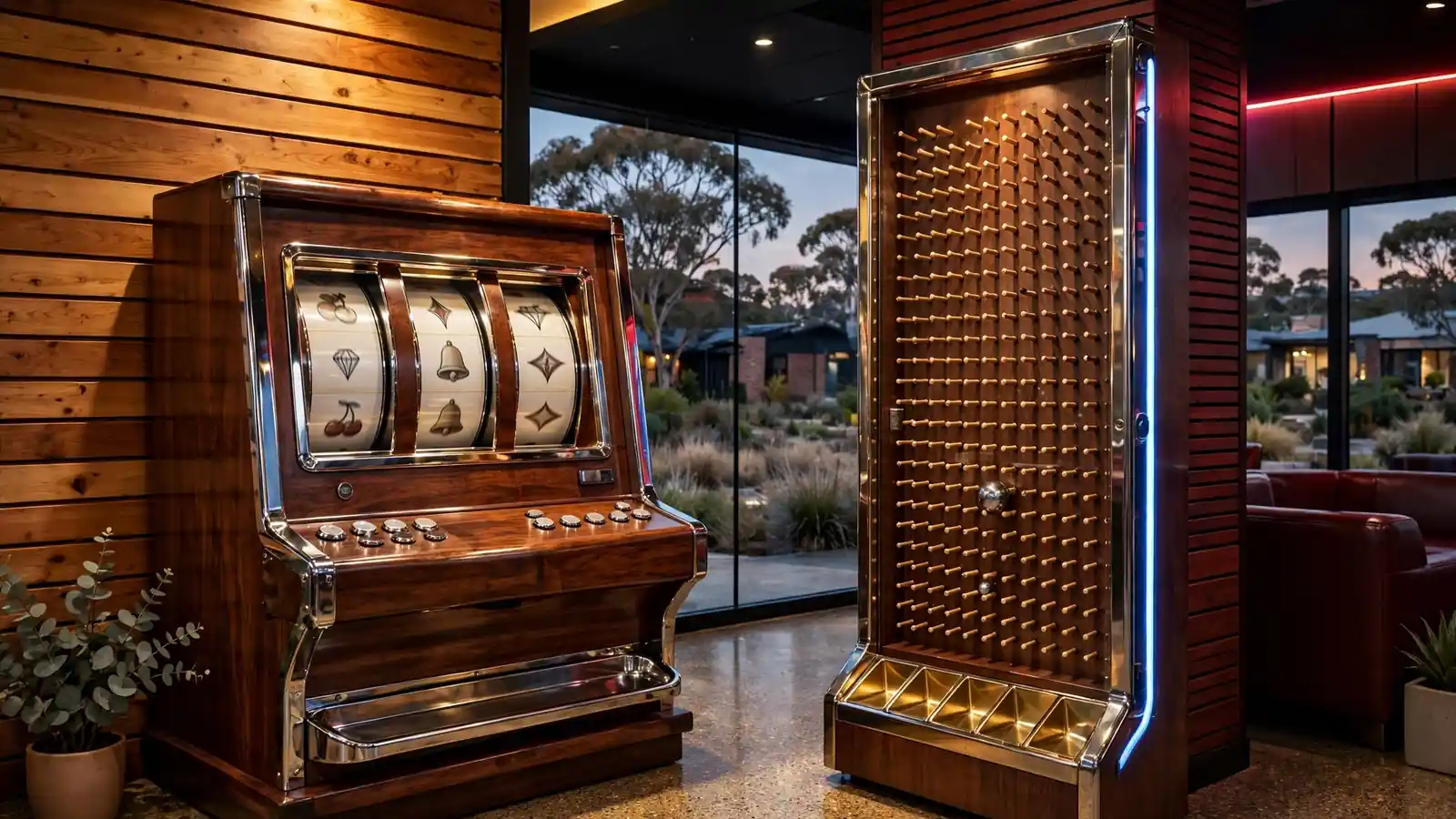
The word “slot” can make very different games sound like variations on one machine. In a pokie, the central event is a set of reels stopping on symbols; in Plinko, a ball falls through a field of pegs and settles in a prize lane. Both can be presented on a screen, and both may sit among casino-style games, but their visual resemblance to familiar gambling formats does not make their play identical.
That distinction matters because names often do more work than mechanics. A Plinko game dressed in bright colours and framed as a slot may borrow the vocabulary of the pokie without borrowing its spinning reels. A product title such as *Gods of Plinko* suggests a theme; it does not, by itself, explain how the game behaves. The same caution applies to labels such as “Plinko Rush” or “Slot Temple”: branding can signal a mood or setting, but the rules and payout structure belong to the individual game.
The older pokie cabinet was designed around a compact ritual: stake, spin, wait for the symbols. Digital versions retain that recognisable structure while adding themes, animations and different feature sets. Plinko shifts the centre of attention from a spin to a visible descent. Its appeal lies partly in watching a ball travel through a branching path, where each peg changes its direction. The outcome is still determined by the game’s design, not by a player steering the ball with skill. A lively animation can make chance feel like a journey. It remains chance.
For Australian players exploring Plinko in 2026, this list offers a concise reference to the available operator details. Use the information provided to check which points matter to you before choosing where to play.
SpinsUp
SpinsUp is listed with a Curacao Gaming Control Board licence, OGL/2023/174/0082, held by Dama N.V.
Thor Casino
Thor Casino is licensed through Antillephone N.V. for Versus Odds B.V. Its minimum deposit is EUR 20.
Kingmaker
Kingmaker lists a minimum deposit of A$30. Its stated payout times are around 90 minutes for crypto and 1–5 days for fiat.
MrPacho
MrPacho lists a minimum deposit of A$30. Its stated payout times are 30–120 minutes for crypto and 24–72 hours for fiat.
Wild Tokyo
Wild Tokyo is licensed in Curacao and lists a minimum deposit of A$10. Its stated payout times are 30–60 minutes for crypto and 1–5 days for fiat.
JeetCity Casino
JeetCity Casino is listed with a Curacao eGaming licence held by Dama N.V.
Roby Casino
Roby Casino is listed with a Curacao eGaming licence held by Roby Games Ltd.
Playfina Casino
Playfina Casino is listed with a Curacao eGaming licence held by Hollycorn N.V. since 2017. Its minimum deposit is A$20–30, depending on the offer.
Golden Pokies
Golden Pokies is listed as licensed in Curacao.
DragonSlots Casino
DragonSlots Casino is listed with a Curacao Gaming Authority licence held by Jumpman Gaming Ltd.
“Plinko slot” is therefore a loose label, not a reliable genre description. Some games use the Plinko name while presenting a ball-drop format; others may place the game in a wider casino catalogue alongside pokies. A so-called Plinko slot machine need not have reels at all. Conversely, a pokie may borrow a falling-object animation without becoming Plinko. The screen supplies a shared surface, not a shared set of rules.
Software providers help shape these differences. Their catalogues can include games with distinct themes, interfaces and mathematical settings, rather than one uniform product repeated under new artwork. KA Gaming, for instance, has slot RTP figures typically ranging from 94% to 96%. RTP is a theoretical return measure across extensive play, not a promise about an individual session or a forecast of what any player will receive. It also should not be transferred from a provider’s pokie catalogue to a separately designed Plinko game: the relevant figure belongs to the particular title and its published rules.
That is a useful boundary when comparing a Plinko game with a pokie. A catalogue may group both under casino games, and a search for a Plinko-style slot may turn up pages that use the terms interchangeably. But a category label cannot establish whether the game has reels, how an outcome is generated, or what return figure applies. Those details require a game-specific description. If none is provided, a familiar title or a polished screen cannot fill the gap.
The difference also explains why the same player may read the two formats differently. Reels make combinations legible: symbols line up, or they do not. Plinko makes movement legible: the ball bounces and the final lane marks the result. One format foregrounds a pattern; the other foregrounds a path. Neither visual language changes the underlying fact that gambling outcomes are not dependable sources of income.
There is a cultural history in that shift. The pokie’s cabinet once made gambling a physical fixture, with buttons, lights and a seat at the machine. The online screen compresses the apparatus into an image, then offers many styles of play within the same interface. Plinko’s falling ball is almost diagrammatic, a small performance of uncertainty. The spectacle is different; the financial risk is not made harmless by a more transparent-looking animation.
Descriptions such as “top Plinko slot” can imply that there is a settled hierarchy, when the label may cover unlike games. A useful comparison begins with the format: reels or falling ball, stated rules, and a game-specific return measure where one is published. “Plinko slots demo” may refer to a no-cash version of a game, but that is a separate question from how a real-money product works. A demo label alone cannot establish the terms or risks of any other version.
Gambling Risks
Gambling is for adults aged eighteen or older; it can cause serious harm, particularly for vulnerable people.
The distinction is not academic. Games are designed to hold attention, and gambling can cause serious harm, particularly for vulnerable people. Gambling is for adults aged eighteen or older; neither a game’s theme nor its format makes it suitable for everyone. A ball dropping between pegs may look less like the old cabinet, but the screen has not abolished the stakes.
Plinko can be presented in many visual forms: a ball dropping through pegs, a live-hosted variation, or a game placed beside familiar casino-style titles. The screen may look like an arcade cabinet, but the legal question in Australia is not settled by its graphics. It turns on the service being offered and whether it involves real-money online casino play for people physically in the country.
The Interactive Gambling Act 2001 draws that boundary at the operator. Providing real-money online casino games to people in Australia is prohibited, including casino-style games such as slots, poker, blackjack and roulette. A Plinko game does not become a different kind of service simply because it borrows the language of a game show or uses a pegboard instead of reels. Nor does describing a site as a “live casino” alter the underlying question of what it offers.
This is why searches for an online casino carrying Plinko, or for a real-money Plinko game, sit awkwardly against the Australian framework. They describe a product category that offshore websites may display, but the presence of a page, logo or playable-looking interface does not make the service lawful to provide to Australians. The distinction is between what a site appears to offer and what operators are permitted to offer here. A familiar interface is not a local permission slip.
The Australian Communications and Media Authority, or ACMA, is the federal body responsible for enforcing the Act and monitoring compliance with interactive gambling laws. Its role is not merely to publish a rule and leave the internet to interpret it. When ACMA identifies a website providing a prohibited service, or advertising one in Australia, it can ask Australian internet service providers to block access to that website.
A block is a measure directed at access through internet providers. It does not turn an offshore service into an Australian one, and it is not a declaration that the site has acquired local approval. The mechanism matters because online gambling services can be operated from elsewhere while being aimed at people here; the regulator’s response therefore reaches beyond the operator’s physical address.
The scale of enforcement is visible in ACMA’s own record. Since November 2019, it has blocked more than 1,455 illegal gambling and affiliate websites after enforcement action. The figure includes affiliate sites as well as gambling sites, a reminder that the regulatory boundary can apply to the machinery surrounding an offer, not only to the page where a game is played.
ACMA Enforcement
Since November 2019, the ACMA has blocked more than 1,455 illegal gambling and affiliate websites.
There is also a reported count of services leaving the Australian market after enforcement began in 2017, but published figures do not match. One account says more than 210 illegal services withdrew; another gives a figure of over 190. The difference should be stated rather than smoothed away. Both describe withdrawals following enforcement, but they are not the same count.
Website blocking is a practical instrument, not the whole of the legal framework. The underlying prohibition concerns the provision of specified interactive gambling services to people in Australia. Blocking addresses the visible route by which a service reaches an audience; the law addresses the offer itself. Confusing those two levels can make an offshore casino seem like an ordinary local business that has merely been inconvenienced by a technical barrier.
That confusion is encouraged by the ordinary habits of the web. A site can use Australian currency, mention local payment methods, or describe its games in language familiar to local players. Those details say little about whether the operator may provide online casino services here. Equally, a search result for Plinko pokies or a casino-style Plinko game is not evidence that ACMA has approved the service. Search visibility is not regulatory status.
The boundary also does not make the player the target of the same prohibition. The law places the restriction on operators providing the prohibited services; Australians are not criminalised simply for using an offshore site. That distinction matters, but it should not be mistaken for endorsement, protection, or a promise that a site will remain reachable. ACMA’s blocking activity shows that access can be interrupted as enforcement proceeds.
The result is a market with a hard legal line and a porous-looking digital surface. Offshore sites may continue to present themselves to Australians, while the federal regulator can act against prohibited services and the websites that advertise them. The screen can look open. The law is not. For people affected by gambling, the consequences can extend well beyond the question of which games appear online; problem gambling can cause serious harm to vulnerable individuals.
A Plinko screen can make the movement of money look as simple as the movement of the ball: a stake goes in, a result appears, and a balance changes. A withdrawal is less theatrical. It is a request processed under an operator’s rules, with thresholds and identity checks that may matter more than the game’s graphics. For Australians searching for real-money Plinko, that administrative layer is part of the subject, not an afterthought.
Offshore sites commonly set minimum withdrawal thresholds between A$75 and A$150. A balance below the stated floor may therefore be visible without being available to withdraw. That distinction is easy to miss when the interface presents one figure as if it were a single, settled sum. In practice, a displayed balance and a cashout-ready amount are not always the same thing.
Attention: A displayed balance may be different from the cashout-ready amount due to minimum withdrawal thresholds typically between A$75 and A$150.
The threshold is a gate, not a promise. Reaching it does not by itself establish that a payment will be approved, or how long it will take. Withdrawal rules belong to the operator, and the amount shown as the minimum is only one part of the process. The practical value of a Plinko result depends not just on what appears on-screen, but on whether the site will accept the request and complete the steps attached to it.
The first cashout can bring another stage: KYC, or identity verification. Offshore operators commonly ask for documents such as a passport or driver’s licence, alongside a utility bill. These are used to establish identity and address before funds are released. A person may have played without encountering that paperwork; the withdrawal request can be where it becomes unavoidable.
That sequence helps explain why a real-money balance should not be treated as cash already in hand. The site’s account display records a number; the payment process involves a request, document checks and the operator’s decision that its requirements have been met. The difference is administrative, but it has a real effect. A balance can feel complete while the transaction remains unfinished.
There is also a human contrast in the paperwork. The game is designed to make outcomes immediate and legible: a ball drops, a compartment lights up, a result is recorded. KYC moves in the opposite direction. It asks for documents, matching details and patience with a process that may feel far removed from the game itself. Casinos have always been good at making chance visible. The institutions behind them are less picturesque.
For a Plinko game or an app presenting itself as a real-money casino experience, the cashout route deserves the same attention as the play screen. A mobile interface does not change the underlying withdrawal threshold or identity requirements. Nor does a downloadable version make the balance equivalent to funds held in a bank account. The device changes the presentation; the administrative relationship remains with the operator.
Australia’s legal setting matters here without making players the target of the rules: the Interactive Gambling Act 2001 restricts operators from providing real-money online casino services to people in Australia. Offshore sites may still be encountered online, but their availability does not turn their casino service into a locally authorised one. Players are not criminalised for using offshore sites. Those distinctions describe different responsibilities, not a guarantee that a withdrawal will be straightforward.
That is why the phrase “real money” can carry more weight than the game itself. It implies a route from a digital balance to usable funds, yet that route may include a minimum threshold and first-cashout KYC. A no-deposit label, a game called Plinko 2.0, or a polished casino app does not make those steps disappear. The crucial point is not how quickly a ball falls, but what must happen before a balance leaves the account.
These processes should not be mistaken for a minor inconvenience. For people vulnerable to gambling harm, the gap between a screen balance and money actually received can intensify pressure to keep playing or to treat a game as financially meaningful. Plinko, like other gambling, is for adults aged eighteen or older; it is not an income source, and gambling problems can cause serious harm. The paperwork is only one part of the risk.
Withdrawal Process
Request and Threshold
The player submits a withdrawal request, provided the balance meets the operator's minimum threshold.
Identity Verification
The operator requires KYC documents, such as a passport or driver’s licence and a utility bill.
Approval and Release
Once identity and address are established and requirements are met, the operator decides to release the funds.
Plinko and a pokie can both turn a small, repeated action into a suspenseful screen: a ball is released, or a spin begins, and the result arrives after a brief interval. That resemblance is a matter of pacing, not of game structure. In Plinko, the visible event is a ball travelling through a field of pegs towards a landing position. A pokie is organised around its own symbols, reels and rules. The shared feeling of waiting does not make the games interchangeable.
The distinction matters most when a jackpot enters the conversation. A progressive pokie jackpot is not simply a large prize attached to any casino game, nor does the presence of a ball imply a growing pool. Progressive jackpots increase as people play linked machines or a network of pokies. The jackpot belongs to that connected system. A Plinko game may have its own payout design, but that alone does not make it progressive or connect it to a pokie jackpot.
There are two broad arrangements. A standalone progressive is local to a particular machine: its prize grows through play on that machine. A networked progressive draws together many machines, or a fleet of games operated online, so play across the linked system can contribute to the same prize. The difference is not cosmetic. One pool is bounded by an individual machine; the other is shared across a wider network.
“Shared” can sound generous, but it describes the plumbing, not the odds of any particular player receiving the prize. The jackpot grows through activity across the connection. That does not mean every stake qualifies, or that every game on a screen is part of the same pool. A casino game Plinko layout and a networked pokie jackpot may sit near each other in a catalogue; proximity is not participation.
Eligibility can hinge on details easy to miss beside the headline prize. A specialist review advises checking both the contribution rate and the minimum bet required to qualify for a progressive jackpot. The contribution rate concerns how play feeds the pool; the qualifying bet determines whether a particular wager is eligible at all. A game may therefore allow play at one stake while reserving jackpot eligibility for another. Those are separate conditions, and the larger prize does not erase the distinction.
Some games set a minimum qualifying bet. A$1.00 is one example, not a universal threshold. The relevant amount and the contribution rule belong to the specific game’s terms. If either is overlooked, a player may be taking part in the base game without qualifying for the progressive prize being displayed. The screen can make the prize feel like part of the game; the conditions decide whether it is.
That is where Plinko and pokies can appear closer than they are. Both may present a simple action and a visible outcome, while the rules behind a payout remain less visible. Yet progressive jackpots are a feature of linked play, not a generic label for a casino game. The ball’s path is not a jackpot network. A rising total on a pokie is not evidence that the same mechanism exists in Plinko.
The format comparison is useful only up to that point. Plinko’s appeal lies in watching a ball move through a fixed arrangement; a progressive jackpot adds a shared pool whose growth depends on linked play and whose eligibility may depend on a qualifying stake. Conflating them turns two different kinds of suspense into one vague promise of a bigger prize. Casino games are for adults aged eighteen or older, and gambling can cause serious harm to vulnerable people. The mechanics deserve plain names. So do the risks.
A review earns its space by explaining what sits behind the headline, not by arranging casinos into a league table. In a Plinko review, that means separating the game’s basic format from the conditions attached to an account or offer. A bright graphic can make a bonus look like a gift. The terms decide whether it behaves like one.
The first distinction is between a bonus balance and cash. Bonus funds are not money available for immediate withdrawal; winnings derived from them may remain subject to wagering checks. One specialist review reports requirements of 30–50 times the bonus amount. That is a description of the terms reported in that review, not a dependable rule for every operator or offer. The number matters only when read beside its definition: whether the requirement applies to the bonus, the deposit, or both, and which games count towards it.
That is where a review can be more than a polished paraphrase of an offer page. It can show the calculation, identify exclusions and explain what happens if a player switches games or cancels an offer. Without those details, “matched” says little. The advertising language is brief; the conditions often are not.
The same discipline applies to titles with similar names. A search for Plinko Rush, Plinko Deluxe or Plinko Verde may point to a named game, a casino label, or a page using those words loosely. A review should establish what is actually being discussed before making claims about its features. Likewise, a reference to MrBeast and Plinko does not by itself establish that a celebrity has endorsed a particular casino or game. Names can travel further than evidence.
A review of Plinko free play has a different subject from one about a real-money offer. The former concerns a version without a cashout; the latter raises questions about the balance, restrictions and withdrawal conditions. Treating them as interchangeable can leave the most important distinction out of the picture.
In Australia, this scrutiny is not a recommendation to use an offshore casino. Real-money online casino services are prohibited for people located in the country, and a favourable review cannot alter that boundary. Its value is narrower: it can make claims legible, distinguish a game from an offer, and show how conditions change the apparent value of a headline.
A useful review leaves the shine intact, but turns on the light.
Plinko’s bright, simple premise can make it look like a category apart from the casino games named in Australian law. A ball drops through a field of pegs; chance supplies the result. But the legal question is not settled by the game’s shape or by whether it resembles a traditional table game. The important distinction is between a game presented for amusement and an online casino service offering real-money play to people in Australia.
The Interactive Gambling Act 2001 restricts operators from providing online casino services to people physically in Australia. That is the central boundary behind the Australian interest in Plinko: when a site offers the game as real-money casino play, its novelty does not remove it from the broader setting of online casino services. A different screen, a different name, or a falling ball rather than spinning reels does not by itself create a separate legal category.
The law’s main target is the service provider, not the individual who visits an offshore site. Australians are not criminalised simply for using offshore gambling sites. That distinction matters. It prevents the operator’s legal position from being casually transferred to the player, while leaving intact the restriction on supplying prohibited services to Australian customers.
Offshore casinos may accept Australian payments while operating under licences issued elsewhere. Payment acceptance is a commercial fact, not proof that the service is authorised to offer online casino games in Australia. Nor does an offshore licence turn into Australian permission simply because the site is reachable or presents itself in familiar language. A border can be easy to overlook on a screen; it remains relevant to the service being supplied.
This is why “Plinko casino” can describe a product in the marketplace without describing a locally permitted form of real-money gambling. The phrase may appear alongside casino branding, but branding does not resolve the legal status. The same distinction applies to other online casino-style games: the question is not whether a game is entertaining or technically unusual, but whether an operator is providing a real-money casino service to people in Australia.
The result is a market divided between Australian law and offshore commercial activity. That division can be confusing because the customer-facing experience may look seamless, while the legal responsibilities sit on different sides of the transaction. The game may travel easily. Permission does not.
A free-play Plinko game offers the shape of the activity without the financial consequence: a ball drops, obstacles redirect it, and a result appears. In a cashless demo, that result is part of the simulation, not money waiting to be withdrawn. The distinction can sound obvious, yet casino interfaces often place practice modes beside real-money features, making two different experiences look like neighbouring settings on the same machine.
That resemblance is the point. A demo lets someone see how a game behaves, but it cannot reproduce the pressure that comes from risking money or the disappointment of losing it. Nor does a simulated result establish that a real-money version has the same rules, odds or terms. “Free” describes the absence of a stake in that moment; it does not turn the game into a promise of future winnings.
Demo Mode
A cashless demo allows a player to see how a game behaves, but it does not reproduce the financial pressure of real-money play.
Free spins sit in a different category. They are a promotional mechanic, not necessarily a no-money practice mode. If they are attached to a bonus, the resulting balance is not cash and may carry wagering requirements before any bonus-derived winnings can be withdrawn. A handful of spins can therefore look like play without cost while still belonging to a commercial offer with conditions.
The Australian context makes that distinction more than a matter of interface design. Real-money online casino games are prohibited when offered to people in Australia, while a game presented as free play should not be mistaken for permission to move into prohibited real-money gambling. The absence of a cashout changes the transaction; it does not erase the wider setting in which casino-style products are marketed.
There is also a quieter reason for the appeal. A no-cashout version removes the bookkeeping of deposits, balances and withdrawals, leaving only the visual suspense of the falling ball. That may suit someone comparing formats, but it is still a simulation, not evidence of a route to income. Gambling can cause serious harm, particularly for vulnerable people; anyone who gambles must be at least eighteen. The game ends at the screen. The consequences need not.
Crypto can make a Plinko balance look more portable than it is. A specialist review describes crypto withdrawals as often clearing faster than other methods, but speed does not settle the amount received. Network fees are deducted along the way, and a conversion spread can widen the gap between the value sent and the value eventually credited. The transfer may move quickly while the arithmetic quietly takes its share.
That distinction matters because a displayed balance and a spendable amount are not the same thing. The relevant comparison is between the value requested for withdrawal and the value that arrives after fees and conversion. A fast transfer is not necessarily an economical one. Nor does the word “crypto” describe a single route: the asset, network and conversion arrangements can affect what reaches the destination. Those details belong to the transaction terms, not to the game’s graphics.
The word “script” points elsewhere. It may refer to code used to build a Plinko game, or to a particular implementation someone hopes to inspect. The label alone establishes neither how the game works nor whether its results can be independently checked. A screenshot, a payment option or a claim that a game is provably fair cannot, by itself, verify the underlying code. Without a named, inspectable implementation and a credible account of how it is tested, certainty would be theatre.
There is also a boundary that payment technology cannot erase. In Australia, real-money online casino services to people physically in the country are prohibited under the Interactive Gambling Act 2001, whether a service presents its Plinko game in conventional currency or crypto. A coin changes the payment rail, not the legal character of the service.
Crypto relates to how value moves and is subject to network fees and conversion spreads. A script refers to the code used to build the game and whether its results can be independently verified.
So the two ideas should not be collapsed into one promise. Crypto concerns how value may move and what can be lost to fees or conversion; a script concerns how a game may be constructed and whether its claims can be examined. Neither is a shortcut to certainty.
A bonus balance can look like a deposit on a screen, but it is not cash. It comes with conditions, and winnings linked to it may remain unavailable for withdrawal until those conditions are met. A no-deposit offer changes how the balance is received; it does not, by itself, remove the rules attached to it.
The arithmetic is simple; the wording around it can be less so. A specialist review gives this illustration: a $100 bonus carrying a 40x wagering requirement calls for $4,000 in qualifying bets before bonus-derived winnings can be withdrawn. That figure describes the example in that review, not a universal casino rule. The operator’s terms determine which bets count, when the requirement starts and whether a balance can expire or be forfeited.
Game contribution rules change the calculation again. A specialist review describes blackjack as contributing only 10% towards wagering requirements. In that example, a stake does not necessarily count dollar for dollar: only the stated share is credited towards the target. A game with a lower contribution can therefore require much more play to clear the same requirement. The headline multiple is only half the arithmetic.
For Plinko, the relevant question is not merely whether a bonus is advertised, but whether the game contributes to its wagering requirement and on what terms. A game title, including one presented to a Dutch-speaking audience, does not settle those details for an Australian player. Country-specific conditions matter, and an offer elsewhere is not proof that the same offer applies here.
The distinction matters because a displayed bonus is not withdrawable money. Bonus-derived funds can be subject to wagering checks, and the rules can limit which games count. Anyone under 18 must not gamble; gambling can cause serious harm, particularly to vulnerable people. A bonus is an obligation dressed as a balance.
A gamble is often described as a private choice, but the scale of poker-machine losses makes the public consequences hard to keep outside the frame. Gamble.com.au reported that Victorian players lost $2.6 billion on pokies over the year covered by its figures, exceeding the 2015 total by more than $44.7 million. The figures do not show who lost what, or what those losses meant inside a household. They do show how a multitude of individual sessions can become a social statistic.
The same report pointed to one venue in Melbourne’s north: its account put the Epping Plaza Hotel’s takings from 100 machines at more than $21 million over the year. A single venue cannot stand for every player or every community. Yet the concentration is striking. The machine is a small private theatre; its revenue is decidedly public in scale.
That tension has shaped calls for reform. Senator Nick Xenophon and MP Andrew Wilkie proposed a $1 maximum bet on poker machines, a limit aimed at slowing the pace at which money could be lost. The proposal made the bet itself a political question: not whether adults may choose to gamble, but how quickly a machine should be allowed to convert that choice into a substantial loss.
A cap cannot settle the broader argument about access, responsibility or the role of venues. Nor do aggregate figures describe the experience of people harmed by gambling. Problem gambling can cause serious harm, particularly to vulnerable individuals; that cost does not disappear because the transaction is legal or the machine is familiar. Reform debates are therefore about more than a number on a screen. They ask which losses society treats as private, and which it is prepared to prevent.
The distinction matters. A great deal.