A parlour label does not establish a casino’s licensing, online authorisation or bonus terms; those claims need separate verification.
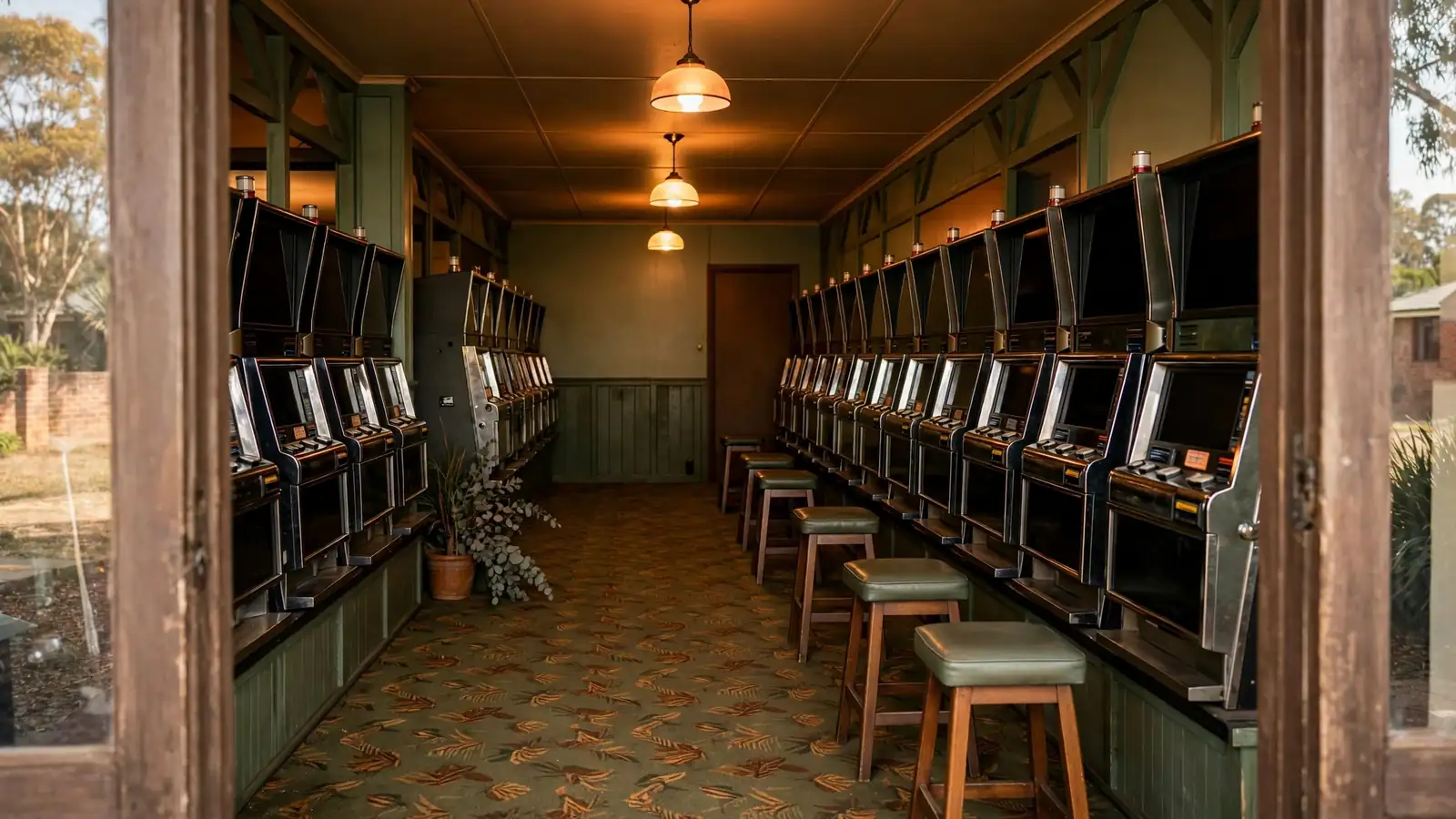
A “pokies parlour” can sound like a service rather than a room: a destination assembled from a familiar word for slot machines and the suggestion of a place to play. In Australia, the distinction matters. A physical casino is a venue with a local licence and premises that people can enter. The phrase alone does not establish that an online casino exists, that a website is authorised, or that the same rules apply to both.
The word *parlour* carries a domestic softness. It suggests a contained room, perhaps even a sociable one. But a casino is not defined by its name or atmosphere. Its status rests on the jurisdiction that licenses the property. Australia’s casino industry is regulated by the state or territory where each venue operates, so there is no single national casino licence that turns every use of “parlour” into a regulated place.
That local structure reflects a broader Australian habit: gambling has been organised through institutions close to the communities and governments that permit it. The arrangement does not make every venue alike. It means the licence belongs to a particular property and jurisdiction, rather than to a loose label that can travel from a building to a webpage.
Choosing a pokies parlour casino in Australia means checking the details that are actually available before deciding where to play. This list offers a concise reference to each operator’s stated licence, deposit minimum or payout information.
SpinsUp
SpinsUp is listed with a Curacao Gaming Control Board licence, OGL/2023/174/0082, held by Dama N.V.
Thor Casino
Thor Casino is listed under a Curacao licence associated with Antillephone N.V. and Versus Odds B.V. Its stated minimum deposit is EUR 20.
Kingmaker
Kingmaker lists crypto payouts at around 90 minutes and fiat payouts at 1–5 days. Its minimum deposit is A$30.
MrPacho
MrPacho lists crypto payouts at 30–120 minutes and fiat payouts at 24–72 hours. The minimum deposit is A$30.
Wild Tokyo
Wild Tokyo is listed as Curacao-licensed, with crypto payouts at 30–60 minutes and fiat payouts at 1–5 days. Its minimum deposit is A$10.
JeetCity Casino
JeetCity Casino is listed under a Curacao eGaming licence held by Dama N.V.
Roby Casino
Roby Casino is listed under a Curacao eGaming licence held by Roby Games Ltd.
Playfina Casino
Playfina Casino is listed under a Curacao eGaming licence held by Hollycorn N.V. since 2017. Its stated minimum deposit is A$20–30, depending on the offer.
Golden Pokies
Golden Pokies is listed as Curacao-licensed; no further operator details are provided here.
DragonSlots Casino
DragonSlots Casino is listed under a Curacao Gaming Authority licence held by Jumpman Gaming Ltd.
A specialist review has described Australia as having more than twenty full-scale casinos across all eight states. That is a sourced snapshot, not a permanent census: venues and classifications can change, and a review’s count should not be mistaken for a timeless official total. Still, it conveys scale. Casinos are part of a national landscape, not a single metropolitan curiosity, even though their distribution and character vary.
The physical meaning of “pokies parlour casino Australia” is therefore less mysterious than the phrasing suggests. It points towards a place where gaming forms part of a venue’s activity, under a local operating licence. It does not, by itself, identify a particular property, describe its facilities, or prove that an online service using similar language has any connection to one.
The online comparison is not simply a matter of the same experience moving onto a screen. Australian law draws a hard line around real-money online casino games: operators may not provide casino-style gambling services to people physically located in Australia. The fact that a phrase can be used for both a physical room and an online offer does not erase that difference. One is a licensed venue in a state or territory; the other raises a separate legal question.
That distinction is easy to lose in internet language, where words such as “parlour,” “casino,” and “pokies” are often joined into a single label. Yet names are not licences. A polished page, a familiar term, or a picture of a gaming floor cannot establish that an online casino is lawful in Australia. The physical venue has a local address and a jurisdictional framework; a web page has neither merely by adopting the vocabulary.
Entry to major Australian casinos is also a physical threshold, not an abstract invitation. Valid photo identification is required at all major casinos, and the minimum age for casino entry is 18 nationwide. These rules make the venue legible as a regulated place: access is checked at the door, and age is not left to the implication of a brand name.
Major casinos operate around the clock. Their doors do not follow the rhythm of ordinary retail, and that continuous access says something about the institution: gambling is built into the venue’s operating model rather than treated as an occasional event. But opening hours do not alter the basic distinction between a real property and an online service. Twenty-four-hour operation belongs to the casinos’ physical schedules, not to every website that borrows their language.
The useful meaning of “pokie parlour” is thus modest. It may evoke a room, a gaming area, or a broader casino setting, but the phrase cannot certify the place, the licence, or the legality of a digital counterpart. In a country where casino permissions are issued locally and online real-money casino services are prohibited, the difference is more than vocabulary. It is the difference between a venue and a promise made on a screen.
A place has boundaries. A label does not.
Attention: A polished webpage or familiar terminology cannot establish that an online casino is lawful in Australia, as physical venues and digital services operate under entirely different legal frameworks.
Australia’s casino geography is not a neat chain of city-centre venues. The named locations stretch from a major coastal city to a regional town and a Gold Coast island precinct. That spread matters: “parlour” can suggest a single familiar kind of room, but the physical setting changes with the place around it.
Sydney is described as Australia’s largest gambling city in a specialist review, which counts 11 gambling facilities there. That is a source-specific snapshot, not a permanent measure of the city or a complete map of its venues. The figure gives a sense of concentration, but the larger point is that gambling facilities sit within an urban landscape rather than forming a self-contained category. A city count cannot tell how each venue is arranged, who enters, or what happens inside.
The other locations make the contrast more tangible. Lasseters Casino is at 93 Barrett Drive in Alice Springs, a named address in a regional town rather than a metropolitan centre. Jupiters Gold Coast Casino & Hotel is on Broadbeach Island, Gold Coast: a site identified not merely by its city but by its position within a distinct island precinct. Country Club Casino is listed on Country Club Avenue, Prospect, in Meander Valley. The addresses do not amount to a national directory; they show how different the idea of a casino’s “place” can be.
An address is useful precisely because it is modest. It locates a property without claiming that all venues share the same scale, atmosphere or relationship to the surrounding community. Broadbeach Island points towards a precinct setting; Barrett Drive gives a street address in Alice Springs; the Meander Valley listing places Country Club beyond the familiar shorthand of a capital-city casino. Those distinctions are more informative than treating “Australian parlour” as a single venue type.
The language of place also carries a social history. Casinos are not just rooms where games happen; they are licensed properties embedded in towns and cities, with boundaries between public space and controlled interiors. The address marks the edge of that arrangement. It says where the venue stands, not what its policies are, what facilities it contains or whether its offer resembles another property’s. Geography can make the category concrete, but it cannot do the work of a venue guide.
That restraint is useful in a country whose gambling map is often flattened into broad labels: Sydney, the Gold Coast, elsewhere. These three listings resist that flattening. One sits in a large city, one on a coastal island precinct, and one in Meander Valley; another named address takes the subject to Alice Springs. They are points, not a ranking and not a claim that the same experience awaits at each.
So the Australian parlour, where the word refers to a physical casino, is less a uniform room than a location-specific institution. Its address gives the first reliable clue: a city, a street, an island precinct, or a valley district. The rest requires venue-specific evidence. Place is a beginning.
The language of a parlour suggests a defined room, perhaps a row of machines and a particular local atmosphere. A national count can establish something narrower: Australia’s casinos have 3,308 gaming machines recorded as both endorsed on venue licences and installed. That figure gives the physical setting a measurable scale. It does not describe a single parlour.
Australia's casinos have 3,308 gaming machines recorded as both endorsed on venue licences and installed.
The distinction matters because a national total is easy to mistake for a directory. It does not show how machines are distributed between casinos, identify which are present at a particular venue, or establish what a room labelled a parlour contains. Nor does the count name games or explain how the machines are arranged. Those are venue-level details, not conclusions contained in an aggregate.
The number also joins two conditions: a machine must be covered by a venue licence and installed in a casino to belong in this total. It is therefore not a count of every machine in every kind of Australian gaming venue. Its boundary is part of its meaning.
That boundary makes the figure useful, but not endlessly so. It supports a statement about the national casino machine inventory; it cannot turn an informal label into a reliable description of a specific place. “Parlour” may convey a layout or mood in ordinary usage, yet the licensed national count does not confirm either. The machines are countable. The imagined room is not.
There is a social detail in this distinction. Regulation records equipment through licences and installations, categories that can be audited more readily than the small customs of a venue. A number says how much is registered and present, not how people gather around it or what a particular room feels like. That is a quieter, more exact answer than the phrase seems to promise.
A national figure, then—not a floor plan.
A page can load, display games and accept account traffic without being authorised to provide online casino play in Australia. Those are signs of technical access, not of legal status. A working address proves that a browser has reached a server; it does not prove that the service may lawfully offer real-money casino games to people in Australia.
That distinction matters because internet access is an unreliable stand-in for public permission. A site can remain visible while its status is disputed, or become difficult to reach after a blocking action. Neither event turns the address itself into a licensing record. A familiar name, polished layout or functioning sign-in page cannot fill that gap.
Australian law draws a firm boundary around online casino-style services provided to people in the country. A service’s use of “parlour” or “casino” in its branding does not move it across that boundary. Nor does describing a mode as free establish that it is lawful real-money gambling; it describes a claimed way to use a site, not the authority behind it. The vocabulary may blur distinctions. The underlying status does not.
The Australian Communications and Media Authority has taken website-blocking action against illegal gambling services. The record includes action involving alternate domains associated with Fair Go. That is a description of enforcement activity, not an endorsement or confirmation that the service is licensed in Australia.
A specialist review has reported that blocking can affect which domains resolve through Australian internet service providers, while alternate addresses may appear over time. This kind of account describes a shifting technical picture, not a reliable route to a lawful service. A replacement address can preserve access for a time; it cannot confer permission. The domain changes. The question does not.
Legal Status
Technical access to a website does not equal legal authorisation; many online gambling services are blocked by the ACMA for being illegal in Australia.
Blocking is also not a complete map of what exists online. A domain that fails to open may have been affected by an access restriction, but the failure alone does not identify the reason. Conversely, a domain that does open has not thereby passed a regulatory test. Internet infrastructure reports whether a connection succeeds. It does not issue licences.
The same caution applies to search results, redirects and messages claiming that a service has moved. A new address can look like a routine housekeeping change, especially when users are accustomed to sites shifting their names. Yet a working redirect proves only that one address points somewhere else. It says nothing about whether the destination is allowed to provide casino services to Australians.
This is why domain lists age badly. An address can disappear, return under another form or be blocked by an internet provider; the sequence can create an impression of a cat-and-mouse contest in which persistence is mistaken for legitimacy. But technical persistence is not legal standing. A service’s ability to attract traffic, keep accounts active or announce a new web address cannot settle its regulatory position.
For anyone trying to understand an online parlour-style offer, the useful distinction is therefore not between an old domain and a new one, or between a page that opens and one that does not. It is between access and authorisation. Access is a property of the connection at a particular moment. Authorisation is a legal question, and a changing web address cannot answer it.
The appearance of a free mode does not alter that test. A page may label games as free, or present a demonstration before account access, but the label alone tells nothing about the service’s standing or the terms under which it operates. It is not a substitute for a clear legal basis. A screen can be persuasive. It remains a screen.
Online availability, then, is a poor proxy for permission. Blocking actions and alternate domains explain why access may change; they do not turn those changes into a method of verifying legitimacy. A website can be reachable and still lack Australian authorisation. A blocked address can be replaced without changing the legal question. Simple, but consequential.
Australia’s casino rules have a federal boundary as well as state and territory ones. The Interactive Gambling Act 2001 makes it unlawful for operators to provide real-money online casino games to people in Australia. The Australian Communications and Media Authority (ACMA) enforces that Act and monitors compliance with federal interactive gambling law. A “parlour” label does not alter the legal character of an online service.
Enforcement is not confined to warnings. ACMA may ask Australian internet service providers to block websites that offer prohibited interactive gambling services or advertise them in Australia. Following enforcement action, the authority has blocked more than 1,455 gambling and affiliate websites since November 2019. That figure describes websites, not a count of casinos or players. A considerable administrative harvest.
The reported number of illegal services that have left the Australian market since enforcement began in 2017 is less settled. One account puts the total above 210; another gives a figure of more than 190. Those reports disagree, so neither should be presented as an uncontested count. Both describe withdrawals following regulatory pressure, rather than a change in the law’s basic position.
That distinction matters when real-money casino services are discussed. ACMA’s role is federal, while physical casino licensing belongs to state and territory jurisdictions. The online prohibition is not a federal licence scheme for offshore casinos, nor does a service’s continued presence on the internet turn it into a permitted Australian offering. Blocking is one enforcement tool; the underlying rule is the line it supports.
For a country accustomed to regulating land-based gaming through local licences, the federal treatment of online casino games draws a different map: jurisdiction is attached to the person in Australia, not to the parlour-like language on a website. The border is legal, not architectural.
A phrase promising a sign-up bonus can look like a simple description of a welcome benefit. In practice, the words alone establish very little. They do not identify a provider, show that an offer exists, explain who could receive it, or prove that it may lawfully be advertised in Australia. “No deposit” is no more conclusive: it describes a supposed absence of an upfront payment, not the terms, status or legality of a promotion.
That distinction matters because promotional language is designed to sound complete before it is. “Bonus” suggests something already available; “sign-up” implies a straightforward exchange between registration and reward. Yet a phrase on a page, in a headline or in a message is not evidence that an actual offer sits behind it. Nor does the presence of a detailed-looking claim make the underlying service lawful.
For people physically in Australia, the legal boundary is decisive. The Interactive Gambling Act 2001 prohibits operators from providing real-money online casino games to customers in the country. Advertising those prohibited services to Australian audiences is also banned. A welcome incentive attached to such a service does not become permissible because it is described as a bonus rather than as gambling. Different packaging, same boundary.
This is why the wording of a purported no-deposit offer cannot be treated as a consumer benefit in the abstract. An offer belongs to a service, and its meaning depends on what that service is and what the promotion would invite people to do. Where the underlying activity is prohibited, the promotion cannot be made acceptable by removing an upfront payment from its description. “Free” does not settle the question. Neither does “welcome”.
The same applies to a sign-up bonus described as being for a pokies parlour. The label does not show whether it refers to a physical venue, an online service, or a loose promotional phrase detached from either. A physical casino and an online casino-style service are not interchangeable simply because a page uses the same words for both. The phrase itself cannot bridge that difference, and it cannot establish that a particular venue or service has approved the offer.
Nor can a reader infer the missing details from familiar promotional conventions. A headline does not disclose eligibility, restrictions, or what action a person would be expected to take. Those details should not be guessed at or supplied from examples elsewhere. Even if a claim lists conditions, the existence of fine print does not establish that the promotion is genuine or lawful in Australia. More text is not the same as more authority.
There is a social history in the appeal of the no-deposit promise. It presents the first step as costless, making an invitation appear less consequential than the activity it leads towards. The language borrows the reassuring manner of a sample or a complimentary extra. But in gambling, the framing cannot be separated from the service being promoted. An apparent gift can still function as advertising for real-money play, and Australian restrictions apply to that advertising as well as to the service.
A responsible account of these phrases therefore cannot turn them into a list of offers, compare supposed rewards, or advise how to obtain one. That would give promotional claims a solidity they have not earned and could promote a prohibited service. The careful distinction is narrower: the words may describe what a page claims, but they do not verify an offer, its conditions, or its lawful availability to people in Australia.
The point is not that every appearance of the phrase proves a particular operator has acted unlawfully. It is that promotional wording, on its own, proves no such offer is available to Australians in the first place. A claim may be current, stale, copied, ambiguous or attached to a service that cannot lawfully provide online casino play here. Without substantiation, those possibilities cannot responsibly be collapsed into a recommendation.
A sign-up bonus is a label, not a finding. “No deposit” is another label, not a safeguard. In this market, neither expression turns prohibited online casino advertising into a valid invitation. The wording may be familiar; its promise is not established.
“Free chips” and “free spins” sound like small gifts attached to a game. In promotional language, though, they are labels, not evidence: the words alone do not establish that a reward exists, who provides it, or what a person would have to do to receive it. A phrase can travel much farther than the offer it claims to describe.
That distinction matters in Australia, where online casino-style games offered for real money are prohibited. The law also bars advertising real-money interactive gambling services, including online casinos, to Australian audiences. A reward described as free does not, by that description alone, sit outside the rules. “Free” is a sales adjective, not a legal category.
The two reward terms suggest different things. A chip may imply credit for use in a gambling game; a spin suggests a turn within a game. But the label cannot establish whether either is available, whether it has a cash value, whether it can be withdrawn, or whether conditions attach.
Nor does a reference to a “parlour” settle what kind of place or service is being described. The word may point toward a physical venue in ordinary usage, while online promotional language can use it more loosely. That looseness is not proof of a venue, a provider, or an authorised offer. It is simply a word doing more work than it can support.
A free-chip claim, then, should not be treated as a promise of usable credit. A free-spin claim should not be mistaken for proof of access to a particular game. Without substantiated terms, neither phrase can tell anyone what is actually being offered.
This is a familiar trick of commercial language: the noun feels concrete, while the conditions remain somewhere out of frame. A chip appears to be an object; a spin, an action. Yet both may function mainly as a headline, inviting the imagination to supply the value that the wording leaves unstated. The missing detail is not a minor footnote. It is the difference between a phrase and a verifiable offer.
Terms like "free chips" and "free spins" are promotional labels. They do not establish the existence of a reward, its cash value, withdrawal conditions, or the provider's authority to offer it in Australia.
In the Australian setting, that gap should not be bridged by treating online casino promotions as ordinary consumer deals. A website’s wording cannot override the law, and a reward label cannot make a prohibited service lawful. Nor does the word “free” establish that no payment, play, or other condition would be involved.
So the sensible reading is restrained: free chips and free spins are promotional expressions, not confirmed benefits. Without clear, reliable evidence of an offer—and without a lawful basis for providing it in Australia—the terms carry no dependable promise. Just words on a screen.
A casino review is only as useful as the thing it has actually examined. A polished description can sound authoritative while leaving the basic question unanswered: is it assessing a physical venue, a website, a particular service, or merely repeating someone else’s account? Those are different subjects, and evidence about one does not settle the others.
For a physical casino, an assessment can be anchored to observable details: the venue’s location, its entry arrangements, the facilities available on site and the experience of moving through the premises. Australia’s casino properties operate under licences issued by their state or territory, and the minimum entry age is 18. Major casinos also require valid photo identification for entry. These are useful reference points, but they do not establish that every description of a venue is current or that every reviewer has personally checked it.
A responsible account distinguishes what can be seen from what is asserted. A building’s address or posted entry conditions may be checked against the venue’s own information; a claim about service quality is an assessment, not a regulatory fact. Even where the description is vivid, the reader should be able to tell whether it rests on direct observation, published terms or an unattributed impression. Fluency is not provenance.
The same discipline matters when “parlour” is attached to an online casino review. A website’s appearance, its account pages or its use of casino language cannot by themselves demonstrate that it is an Australian-licensed gambling service. Indeed, real-money online casino games are prohibited for operators providing them to people in Australia. A review that blurs the difference between a physical casino and an online service has not merely chosen a loose label; it has blurred the subject being judged.
That distinction changes what counts as a meaningful verdict. A review of a venue can describe its public-facing facilities and entry rules. A review of an online service would need to establish what service is being assessed and how its claims are supported, rather than treating a functioning web address as proof of legitimacy. Access is not a credential. Nor does a confident rating turn an unsupported statement into a checked fact.
Reviews also have a shelf life. Operating details can change, and a description written at one point may no longer match the venue or service it names. The date and scope of an assessment therefore matter as much as its adjectives. “Good,” “trusted” and “best” are conclusions; without a stated basis, they are decoration.
A useful review does not pretend to know more than it can show. It separates observation from opinion, identifies the subject clearly and keeps legal status distinct from atmosphere or convenience. That is less theatrical than a star rating. More useful, too.
“VIP” carries the suggestion of a threshold: a room beyond the ordinary room, an invitation, perhaps a different set of privileges. Attached to a casino parlour, it can sound like a description of a particular place. The label alone establishes none of that.
It does not identify a venue, prove that a membership scheme exists, or explain who could enter. Nor does it establish special services, reserved areas or different conditions of access. Those details would need to come from a clearly identified, current source; without them, the phrase remains a name-like claim rather than a useful account of what a venue provides.
There is a reason such language travels easily. “VIP” borrows the vocabulary of hotels, clubs and entertainment, where distinction can be made to seem self-evident. But a word of status is not a map of a room. In Australia, casino properties operate under licences issued by their state or territory, while the label itself does not replace the rules governing a venue. The distinction is less glamorous than the word.
The phrase may also appear beside online casino material. That association should not be mistaken for proof of a local service or lawful access. Australian law prohibits operators from providing real-money online casino games to people in Australia; a VIP label does not alter that position.
A careful description therefore stops at what the wording can support: someone is presenting a casino-related offer or space as exclusive. It cannot, by itself, say who qualifies, what the arrangement includes, or whether any named parlour exists. The absence of those particulars matters. Status without particulars is theatre.
A bonus headline is an assertion, not a set of terms. The word may suggest extra value, but it cannot establish who qualifies, what must be done to receive it, or whether anything can be withdrawn. Without those details, a claim about a casino bonus says little about the actual arrangement. A generous adjective is not fine print.
That distinction matters in Australia because real-money online casino services are prohibited when offered to people in the country. The Interactive Gambling Act 2001 bars operators from supplying online casino-style games to customers located in Australia, and advertising those services is also prohibited. A bonus attached to such an offer does not turn the underlying service into a lawful one. Nor does a polished promotion settle its status.
The language can travel farther than the offer itself. A phrase may appear in a banner, a page title or a message describing a supposed reward, while the terms that would give it substance remain obscure or absent. Even a detailed-looking promotion cannot, by its appearance alone, establish that the service may legally be provided in Australia. Presentation is not permission.
There is no sound basis for treating a general claim of a pokies-parlour bonus as evidence of a particular reward, eligibility rule or payout condition. Those are separate matters, each requiring clear and applicable terms. Without them, claims about value remain just claims; adding a specific figure or condition would create precision from nothing.
The law also makes the promotional setting significant. Advertising real-money online casino services to Australian audiences is banned, so bonus language should not be read as an invitation or recommendation. It cannot be made acceptable simply by placing it beside neutral wording or a disclaimer. The old commercial trick of making an inducement look like information does not change what is being promoted.
Physical gaming venues and online services belong to different settings, but a bonus claim alone does not identify which setting applies or establish its terms. The label may sound familiar; its legal and practical meaning depends on what is actually being offered and where. In Australia, the boundary around online casino services is not a footnote to a promotion. It is the central fact.